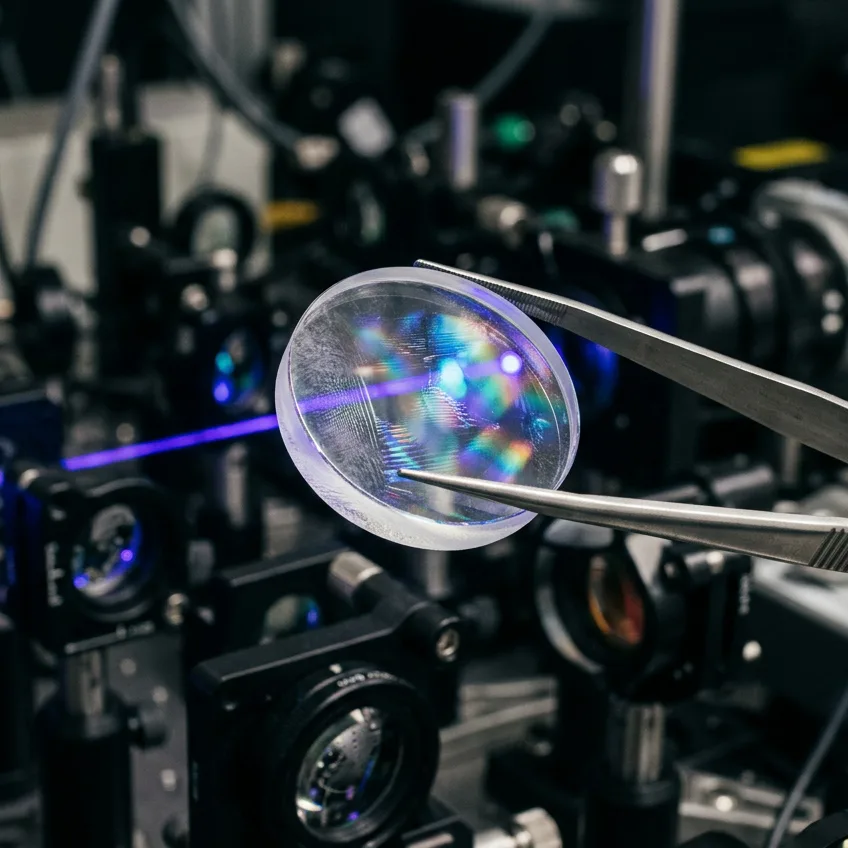
In an era where mechanical hard drives and solid-state drives barely guarantee file integrity for a decade, researchers at the Optoelectronics Research Centre of the University of Southampton developed a definitive solution: the 5D memory crystal, informally dubbed the "Superman memory crystal."
This medium consists of a tiny disc of pure quartz glass (fused silica) the size of a coin, capable of storing up to 360 terabytes of information. The feat is achieved using a femtosecond laser—which emits pulses of light in a quadrillionth of a second—to etch three-dimensional nanostructures inside the glass matrix.
The "five-dimensional" concept comes from the fact that information is not only encoded in traditional three spatial coordinates, but through two additional optical parameters:
- Conventional spatial coordinates (X, Y, and Z axes).
- The relative size of the etched nanostructure.
- The birefringent orientation of the structure, which alters the polarization of light passing through it.
The thermal and physical stability of the medium challenges the scale of civilization. The crystal withstands direct temperatures of up to 1,000 °C, and at room temperature its degradation is estimated to take 13,800 million years, a period equivalent to the age of the known universe. Crucial texts such as the Universal Declaration of Human Rights and Isaac Newton's Opticks have already been encoded in this format, securing an indestructible time capsule for human memory.
Source: University of Southampton - Optoelectronics Research Centre (ORC)