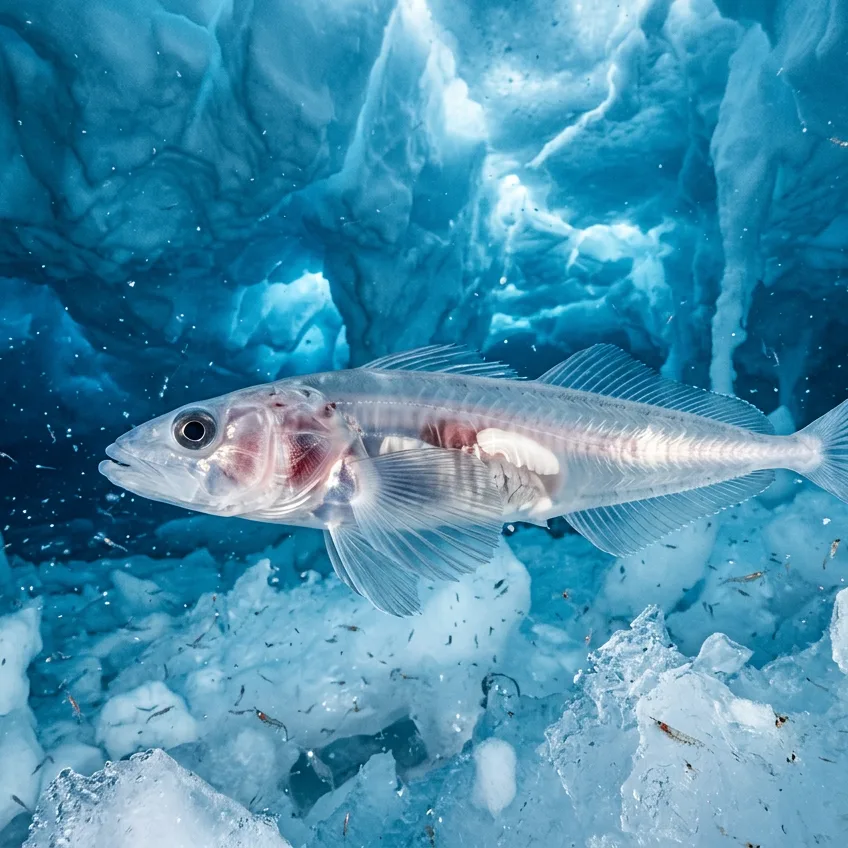
At subzero temperatures in the depths of the Southern Ocean lives an animal that defies the fundamental rules of vertebrate physiology: the Antarctic icefish (family Channichthyidae). It is the only known group of vertebrate animals that lacks functional hemoglobin and red blood cells in adulthood, turning its blood into a whitish, completely translucent fluid.
In almost any other animal with a backbone, doing without the protein responsible for transporting oxygen would cause instant suffocation within seconds. However, this fish thrives thanks to a series of extreme adaptations:
- Oxygen dissolved in plasma: Antarctic water, at temperatures down to -1.9 °C, is extremely rich in dissolved oxygen. The fish dispenses with iron carriers and dissolves the gas directly into its watery blood plasma.
- A colossal circulatory system: To compensate for the lower oxygen density, it has a heart four times larger by volume than that of other fish of similar size and pumps a gigantic volume of blood at low pressure.
- Scaleless skin and dilated capillaries: Lacking scales, it absorbs a considerable amount of oxygen directly through its skin, supported by noticeably widened blood vessels.
In addition, to avoid freezing in waters that would kill other fish, its body synthesizes potent antifreeze proteins that prevent the growth of ice microcrystals inside its cellular tissues. This evolutionary marvel shows how extreme environmental pressures can dismantle and redesign the most consolidated biological foundations of the animal kingdom.
Source: Nature Ecology & Evolution (Genomic study of Chaenocephalus aceratus, 2019)