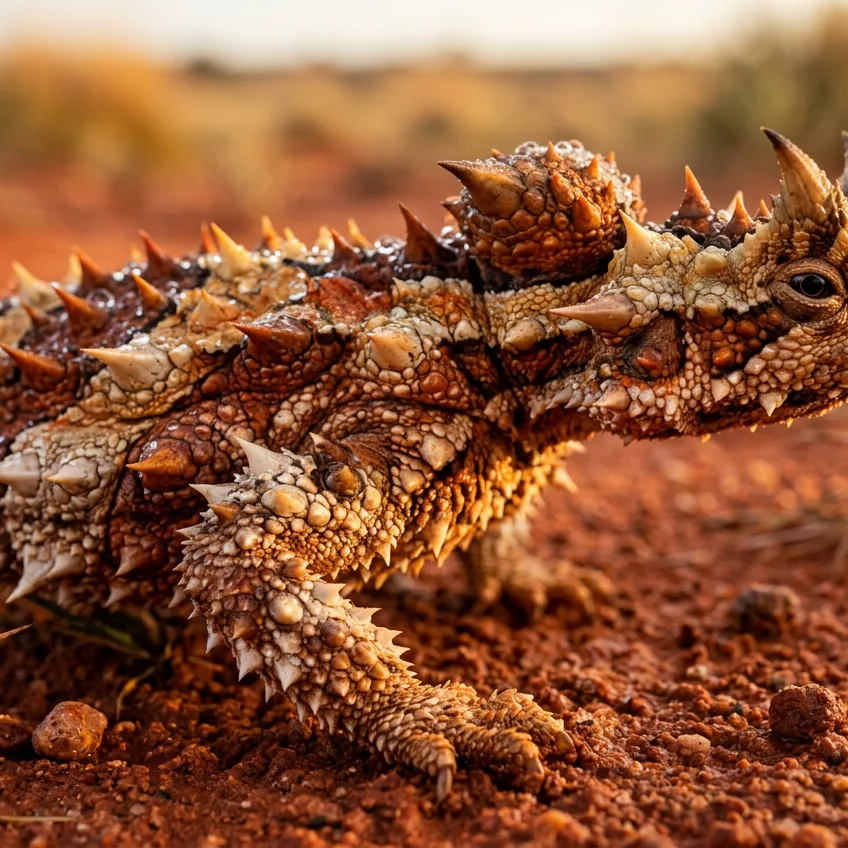
In the arid deserts of central Australia, where rainfall is unpredictable and standing water is a mirage, the thorny devil (Moloch horridus) has perfected one of the most fascinating anatomical adaptations in the animal kingdom. This small, prehistoric-looking reptile, covered in an armor of hard conical spines, can quench its thirst simply by stepping on damp mud or brushing morning dew condensation with its abdomen.
The secret lies not in absorbent pores, but in a network of capillary microchannels located in the interstices of its keratin scales. The grooves, with a diameter between 100 and 150 micrometers, act like tiny microscopic straws. When any part of the reptile's body touches moisture, water surface tension and molecular adhesion forces automatically pull it into the channels, driving it upward against gravity.
Biophysical research has revealed astonishing details about this passive system:
- Unidirectional flow: The asymmetric geometry inside the scales promotes the liquid's movement toward the head, preventing it from flowing backward.
- Jaw pumping: Once the capillaries fill and the water reaches the corners of its mouth, the reptile only needs to rhythmically open and close its jaws to swallow the liquid.
- Sand mining: If the environment is extremely dry, the animal partially buries itself in sand with a modest 1 % moisture content and manages to extract it via capillarity.
This evolutionary mechanism not only ensures its survival in one of Earth's most hostile habitats, but has also served as a model for developing biomimetic surfaces capable of harvesting atmospheric water and transporting fluids without electric pumps.
Source: Journal of the Royal Society Interface (Comanns et al., 2016)