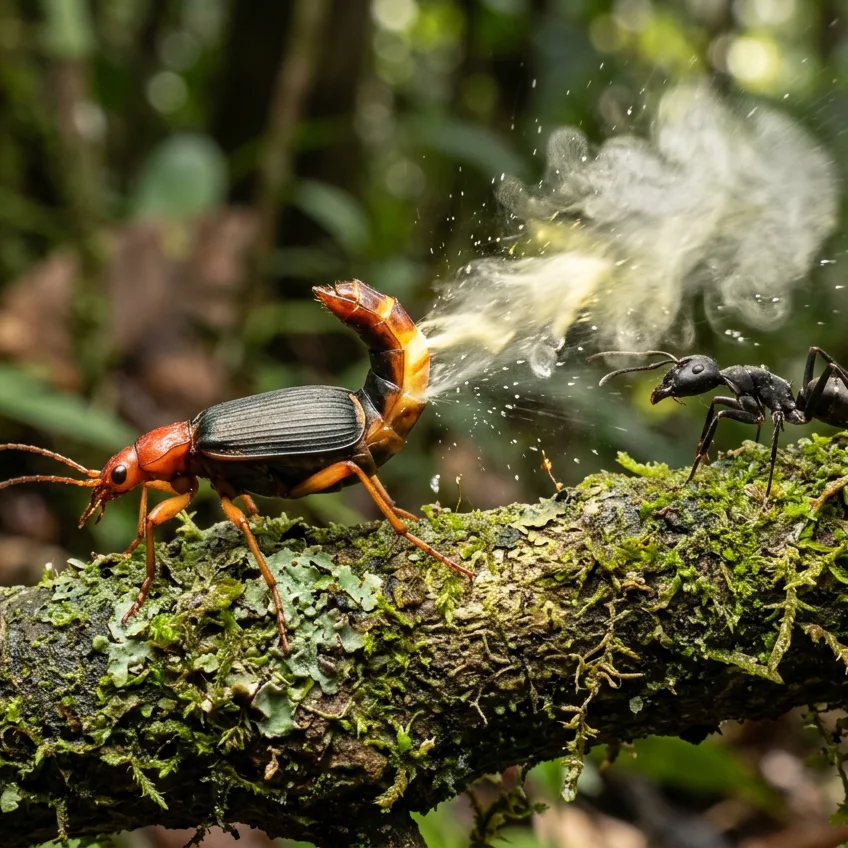
In the insect world there are astonishing chemical defenses, but none rival the ballistic sophistication of the bombardier beetle (family Carabidae). When an ant, spider, or frog tries to make it prey, this beetle does not run away: it activates a microscopic combustion chamber at the tip of its abdomen that ejects a caustic cloud of liquid and steam at 100 °C.
The secret of this insect lies in its complex two-stage anatomical system:
- Passive storage: It has two separate reservoirs where it stores an aqueous solution of hydroquinones and hydrogen peroxide, two compounds that remain stable as long as they stay isolated.
- Reaction chamber: When it feels threatened, abdominal muscles open sphincters that empty both substances into a cavity with chitin-reinforced walls. There, they come into contact with catalytic enzymes (catalases and peroxidases).
The resulting chemical reaction is extraordinarily violent and exothermic. The hydrogen peroxide decomposes into water and oxygen gas, oxidizing the hydroquinones into irritating p-benzoquinones. The released heat instantly boils the liquid, generating massive steam pressure.
High-speed X-ray studies at MIT revealed that the beetle does not fire a continuous stream, but rather ultrafast pulses between 500 and 1,000 bursts per second, a mechanism identical to the one that propelled V-1 flying bombs. In addition, its anal nozzle can rotate 270 degrees, allowing it to aim with lethal accuracy in any direction without burning its own tissues.
Source: Science / MIT News