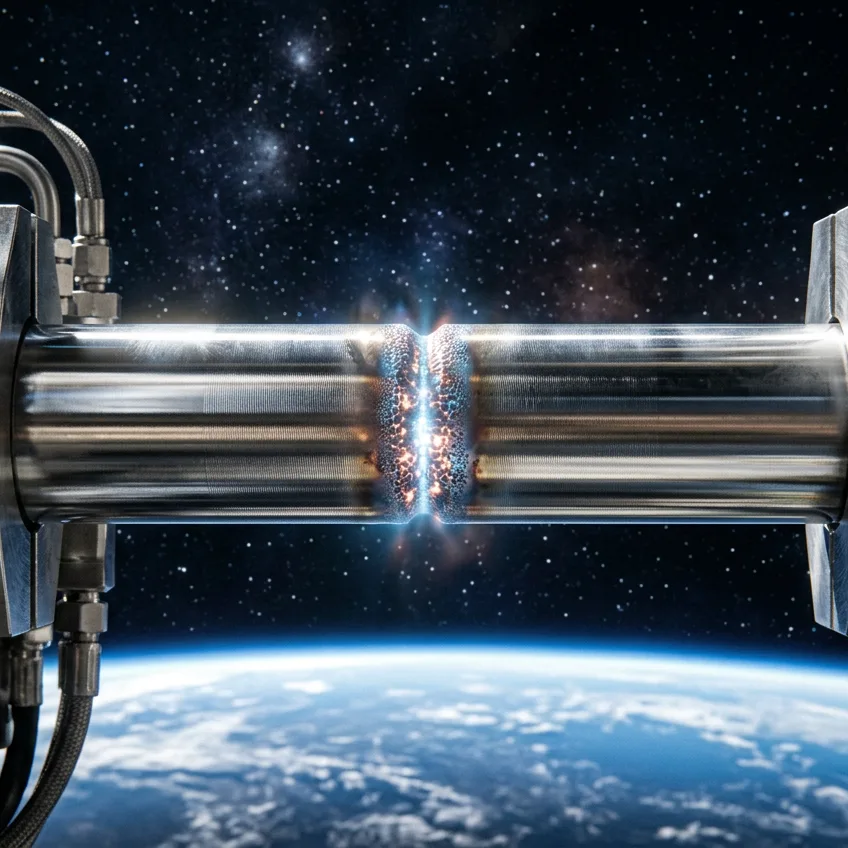
If you take two blocks of polished copper on Earth and bring them together, nothing out of the ordinary happens. However, if you repeat the exact same gesture in the absolute vacuum of outer space, both pieces instantly become a single, solid, and indivisible block, without the need for heat, sparks, or flux.
This astonishing physical phenomenon is known as cold welding or contact welding. On our planet, metals never truly come into intimate contact at the atomic level: the atmosphere reacts almost immediately with any exposed metal surface, creating a thin oxide film and trapping microbubbles of air and moisture that act as a microscopic insulating shield.
In space, on the other hand, the near-total absence of molecules eliminates this protective barrier. As physicist Richard Feynman famously explained, when two ultra-clean surfaces of the same metal touch in a vacuum, the atoms in one piece have no way of knowing they do not belong to the other. The clouds of free electrons overlap spontaneously, and metallic bonds reestablish themselves at room temperature in milliseconds.
This effect represents a real challenge for aerospace engineering:
- Critical jamming risk: Gears, hatches, and articulated arms on probes and satellites can become permanently welded together if two bare metals rub against each other.
- The Galileo probe incident: In 1991, the high-gain antenna on this NASA mission failed to open completely en route to Jupiter due to the cold seizure of several titanium ribs.
- Advanced solutions: To prevent it, space components are coated with ceramic films, molybdenum disulfide dry lubricants, or ultra-thin gold plating.
Source: NASA Technical Reports Server (NTRS) & The Feynman Lectures on Physics