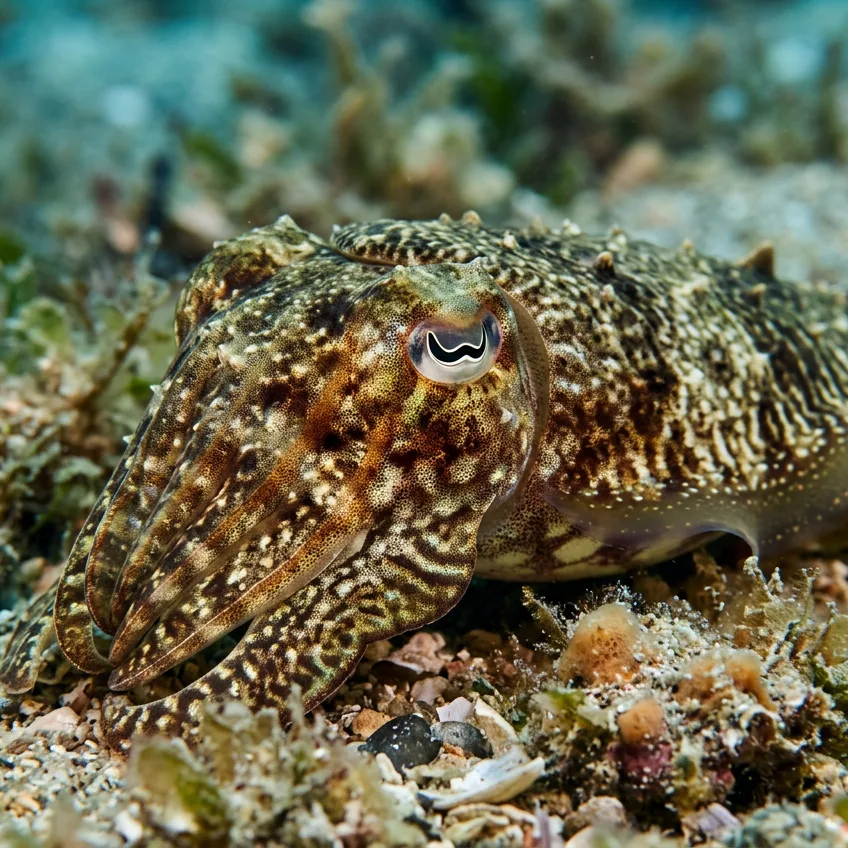
On marine reefs, the common cuttlefish (Sepia officinalis) performs one of nature's greatest visual feats: it changes the tone, contrast, and texture of its skin in under two hundred milliseconds to become virtually invisible. What is puzzling to science is that this cephalopod is, physiologically speaking, completely color-blind. Its retina contains only a single type of photoreceptor protein, which in any vertebrate would mean seeing the environment strictly in grayscale.
How does it manage to flawlessly replicate the vivid colors of algae and corals? A team of researchers from Berkeley and Harvard solved the physical mystery behind its gaze:
- "W"-shaped pupils: Far from being an aesthetic quirk, this irregular slit directs light preferentially toward the periphery of the lens, maximizing a specific visual distortion.
- Intentional use of chromatic aberration: While human eyes and camera lenses correct this optical defect, the cuttlefish exploits it. As it refracts through the lens, each wavelength (color) converges at a different focal plane. By rapidly moving the lens forward and backward, the cuttlefish knows which color is before it by gauging the sharpness of blur on its retina.
- Ultra-active chromatophore skin: Once the wavelength is calculated, millions of elastic pigment cells (chromatophores) and biological reflectors (iridophores) expand via direct neuromuscular control.
By transforming a seeming physical flaw into a sophisticated spectral analyzer, this invertebrate defies the rules of animal vision without needing color cones.
Source: Proceedings of the National Academy of Sciences (PNAS)