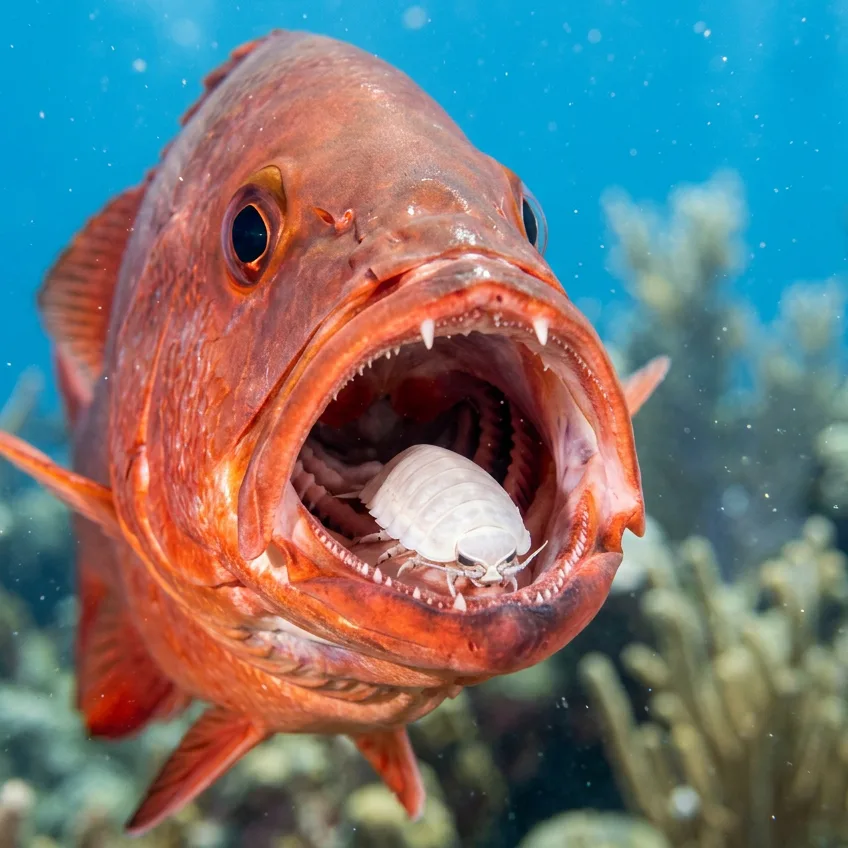
In the underwater realm, there is an isopod crustacean with one of the most unusual adaptation strategies on the planet: Cymothoa exigua. This invertebrate, a distant relative of terrestrial woodlice, holds the biological record of being the only parasite discovered to date capable of mechanically and functionally replacing an entire organ of its victim.
The process begins when the parasite enters through the gills of fish such as the red snapper. Curiously, all individuals are born male, but upon invading the fish's mouth, the dominant specimen changes sex to female and experiences noticeable growth. With its sharp rear legs, the female clings to the base of the host's tongue and severs its blood supply. Deprived of nutrients and oxygen, the fish's tongue completely atrophies until it necroses and falls off.
At that moment, the singular feat occurs:
- Biological prosthesis: The parasite anchors itself firmly to the remaining muscular stump and assumes the physical role of the lost organ. The fish learns to move the crustacean to press prey against the roof of its mouth and swallow normally.
- Shared survival: The parasite feeds on oral mucus and tiny amounts of blood, keeping the fish alive for years to guarantee its own shelter.
This unsettling relationship shows how far coevolution can design extreme biomechanical solutions in the marine environment.
Source: Journal of Fish Biology