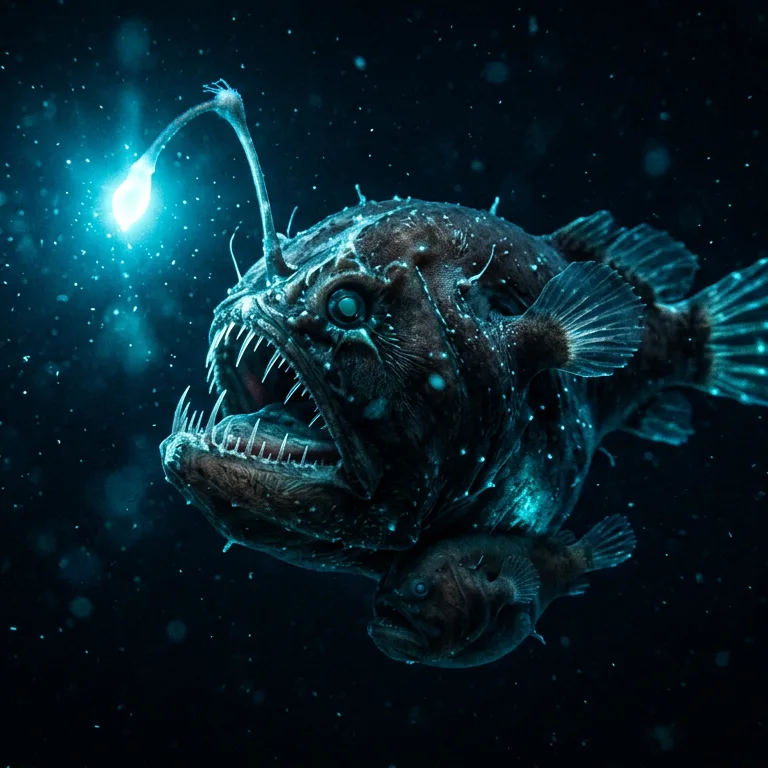
More than a thousand meters deep, in the absolute darkness of the bathypelagic zone, finding a mate of the same species is a minuscule mathematical probability. To solve this reproductive crisis, several families of deep-sea anglerfish (such as Ceratiidae) have evolved the most radical mating strategy in the animal kingdom: obligate sexual parasitism.
The male of these species is born tiny, measuring just a fraction of the colossal female's size, and lacks the characteristic bioluminescent lure. Equipped only with an enormous sense of smell and giant eyes, his only life mission before starving to death is to track the pheromones of a female. When he locates her, he latches onto her belly and bites her with pincer-like jaws.
From that moment on, a disturbing anatomical metamorphosis takes place: the male's lips and skin dissolve through enzymes, fusing his cellular tissue with that of the female. Gradually, the blood vessels of both connect, creating a shared circulatory system. The male stops eating on his own; his eyes, fins, stomach, and heart atrophy until they nearly disappear. He is reduced to a permanent living mass of testes attached to the female's skin, ready to release sperm in unison whenever the hormones in his host's blood signal it.
Scientists from the Max Planck Institute discovered in 2020 that, to avoid fatal immune rejection during this tissue fusion, these fish have completely disabled key genes of the adaptive immune system, a genetic anomaly that would kill any other vertebrate on Earth.
Source: Science magazine (Swann et al., 2020: 'The immunogenetics of sexual parasitism in anglerfishes')