When we think of nuclear fusion, our minds usually wander to monumental infrastructures like the ITER project or thermonuclear bombs, where plasmas at over one hundred million degrees Celsius require colossal magnetic fields to be compressed. However, in 2005, a team of physicists from the University of California, Los Angeles (UCLA) demonstrated that the power of the atom can also fit on an ordinary desktop.
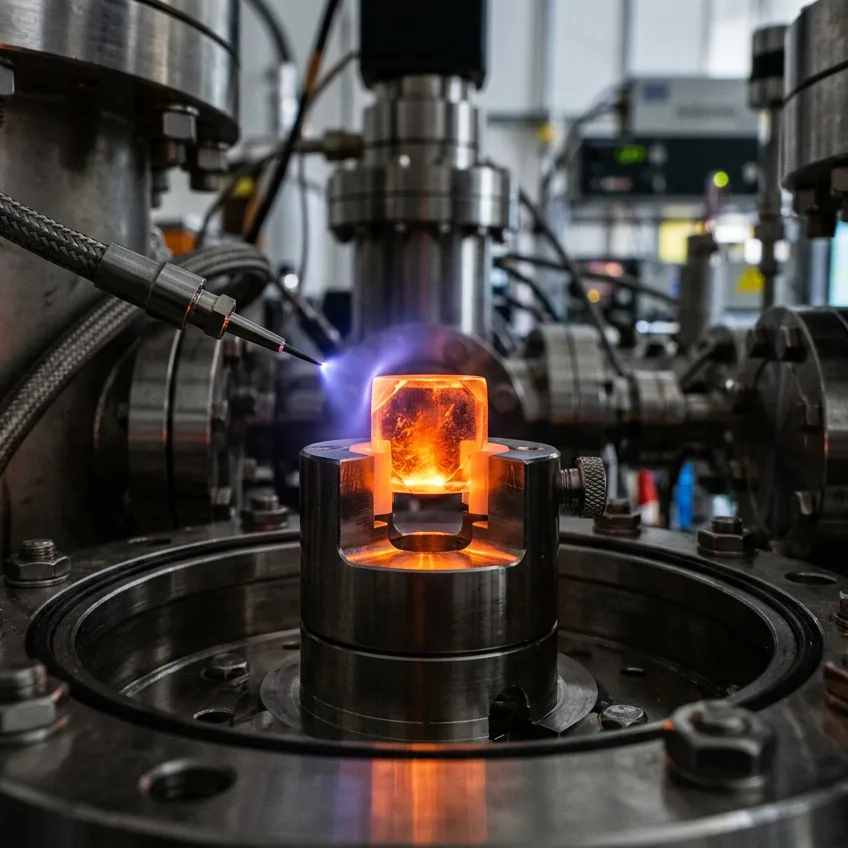
The heart of this feat was a tiny pyroelectric crystal of lithium tantalate. These crystals possess an extraordinary physical peculiarity: when they experience a very slight thermal variation—as simple as gradually heating from -50 °C to room temperature—the spontaneous reorganization of their atoms generates a colossal electric field, capable of reaching over 100,000 volts per centimeter.
Harnessing this phenomenon, researchers enclosed the crystal in a vacuum chamber filled with deuterium gas (a heavy isotope of hydrogen) and attached an extremely fine tungsten needle. The electrostatic field concentrated at the tip ionized the gas and shot deuterium ions at incredible speeds toward a target. Upon colliding, the nuclei overcame their natural electrical repulsion barrier and fused, releasing a clear emission of neutrons and helium-3.
Although the device does not generate a net gain of usable energy as a mass power source, it revolutionized applied particle physics: today it allows the creation of portable neutron sources that fit in a backpack, used for customs security scans and precise medical radiation therapy.
Source: Nature (Observation of nuclear fusion driven by a pyroelectric crystal, Naranjo et al., 2005)