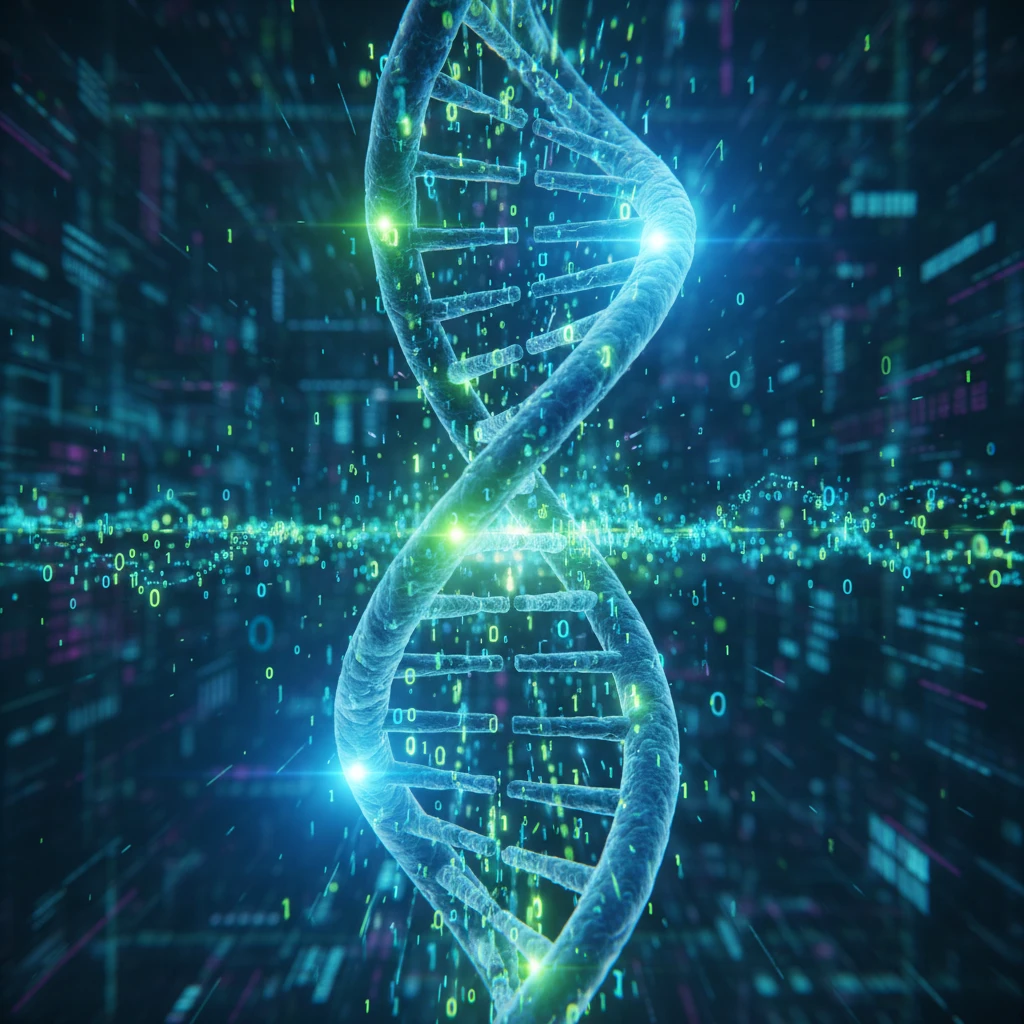
Computing has been dominated by silicon for decades, but a new frontier emerges from the heart of biology: DNA computing. This revolutionary technology uses the molecules of our genetic material not only to store information, but to actively process it, offering a radically different paradigm from traditional microchips.
Unlike transistors that operate with electricity, DNA computers function through biochemical reactions. Each strand of DNA can encode a piece of information, and the natural interactions between these strands (such as complementary base pairing) turn into logical operations. Imagine billions of these "operations" occurring simultaneously in a single drop of liquid, a level of parallelism that far surpasses any current supercomputer.
One of the most fascinating applications is solving extremely complex problems that challenge conventional machines, such as the famous "traveling salesperson problem." In 1994, Leonard Adleman demonstrated for the first time that a solution to this problem could be found through DNA manipulations, opening the doors to a new field. These systems are incredibly energy-dense, as much of the processing occurs passively through chemistry.
Although it is still in its early stages, DNA computing has the potential to transform fields such as medicine, enabling ultra-precise diagnoses or even the creation of DNA "nanorobots" that perform tasks inside the body. Current challenges include reaction speed, assembly accuracy, and the interface with conventional electronics, but progress is steady. We are on the verge of an era where biotechnology and computer science merge, bringing computational intelligence to the molecular scale.
Source: Adleman, L. M. (1994). Molecular computation of solutions to combinatorial problems. Science, 266(5187), 1021-1024; Nature Biotechnology, MIT Technology Review.