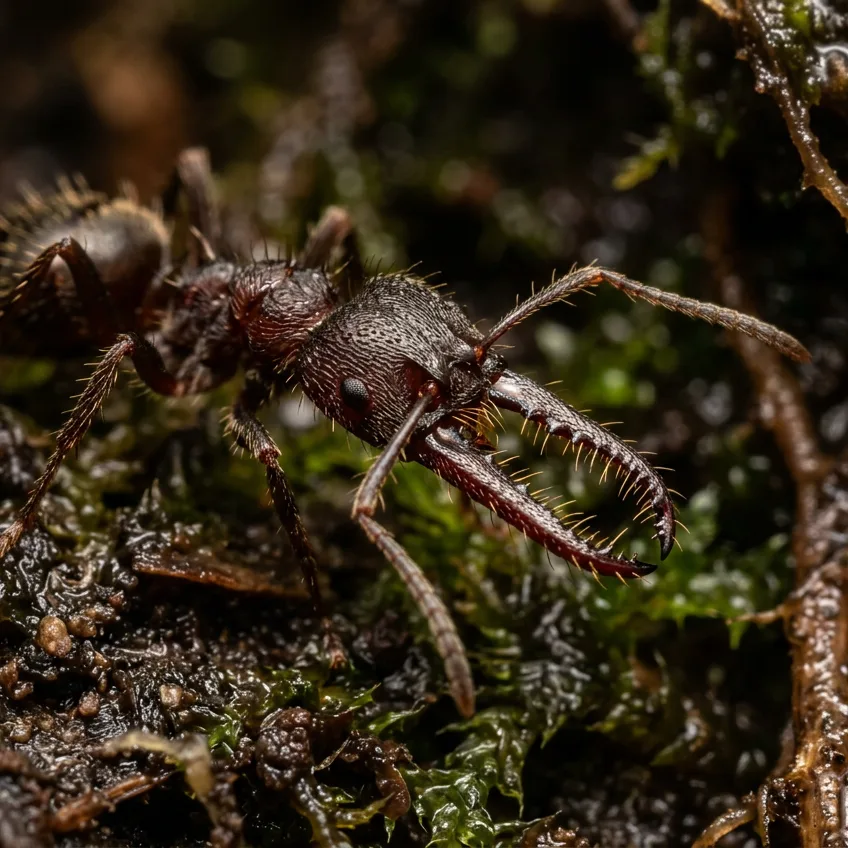
For decades, the biomechanical acceleration record was thought to belong to the pistol shrimp or certain trap-jaw ants. However, a study led by the University of Illinois and the Smithsonian Institution revealed that the true pinnacle of speed on Earth belongs to the Dracula ant (Mystrium camillae), a tiny inhabitant of Southeast Asia and Oceania.
This subterranean species can snap its mouthparts at a speed of 90 meters per second (more than 320 km/h). The entire process takes just 23 microseconds, 5,000 times faster than a human blink, with an acceleration exceeding 100,000 g.
The secret behind such kinetic violence does not lie in direct muscular force, but in a sophisticated elastic system:
- Spring mechanism: The ant presses the tip of one mandible tightly against the other, flexing its head cuticle and storing elastic energy like a fully drawn bow.
- Snap effect: When an anatomical latch slides free, the loaded mandible releases abruptly, functioning similarly to a human finger snap.
- Blunt impact: The resulting strike does not cut; instead, it delivers a brutal kinetic shock designed to instantly stun tough prey like centipedes.
The name "Dracula ant" comes from another of its fascinating biological traits: unable to digest solid prey directly, the workers feed their larvae and then gently pierce their skin to feed on their hemolymph without killing them, a phenomenon known as nondestructive cannibalism.
Source: Larabee, F. J., et al. (2018). 'Snap-jaw morphology and kinematics in Mystrium camillae'. Royal Society Open Science.