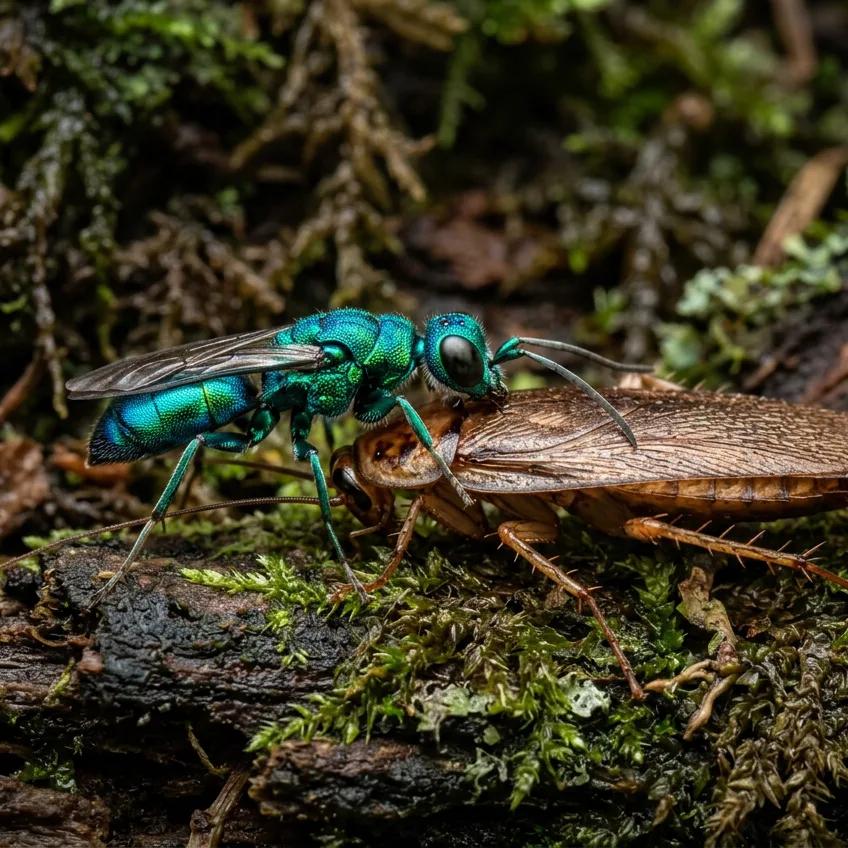
In the animal kingdom there are lethal parasites, but few match the precision of Ampulex compressa, the emerald jewel wasp. This metallic green hymenopteran does not eliminate its victim, a cockroach that can weigh four times its mass, but instead carries out true millimeter chemical neurosurgery to turn it into a docile automaton.
The attack is structured in two sequential strikes:
- Preventive immobilization: The wasp delivers a precise first sting to the thorax that paralyzes the cockroach's front legs for a couple of minutes, neutralizing its defense.
- Brain injection: With the prey immobilized, it inserts its stinger through the head capsule. Guided by sensory chemoreceptors at the tip of the stinger, it locates two tiny areas with surgical accuracy: the subesophageal ganglion and the protocerebrum.
The injected venom disrupts the pathways of octopamine, a key neurotransmitter that activates the alertness and escape response in arthropods. The biological effect is striking: the cockroach retains its motor skills intact and can walk, but completely loses the motivation to escape; its survival instinct is canceled.
Next, the wasp partially trims the insect's antennae to feed on its hemolymph and pulls on the stumps as if holding a leash. The cockroach follows on foot into an underground burrow without resisting. There, the wasp lays an egg on its leg and seals the den with pebbles; the larva will methodically consume the non-vital organs of the living host before pupating and emerging into the open.
Source: The Journal of Experimental Biology (Research by neurobiologist Frederic Libersat on Ampulex compressa)