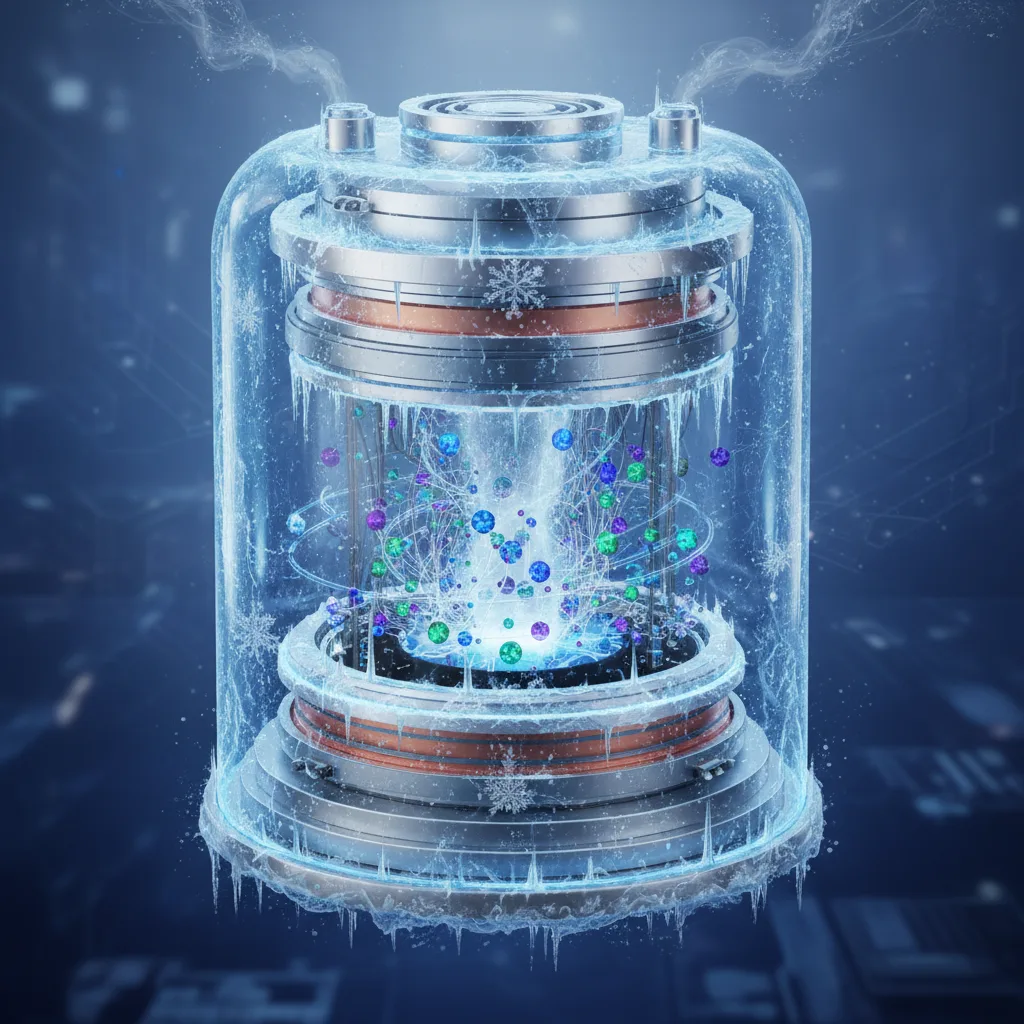
While your smartphone processes information at room temperature, quantum computers require a radically different environment to function: extreme cold. We are talking about temperatures of a few millikelvins, colder than deep interstellar space and approaching absolute zero (0 Kelvin or -273.15 °C).
Why this obsession with the cold? The key lies in qubits, the fundamental units of quantum information. Unlike classical bits (0 or 1), qubits can exist in a superposition of both states simultaneously and link through entanglement. For these quantum phenomena to persist and be useful, qubits must be isolated almost perfectly from any external interference. Heat, in the form of random atomic vibrations, is the greatest enemy of this "quantum coherence."
To achieve these ultralow conditions, engineers use sophisticated dilution refrigerators that cool quantum chips layer by layer, using a mixture of helium-3 and helium-4. This extreme insulation allows qubits, often built with superconducting materials, to maintain their delicate quantum states long enough to perform complex calculations.
This technological challenge is immense, but the potential is even greater. Quantum computers promise to solve problems that lie beyond the capabilities of any current supercomputer, from designing new materials and medicines to optimizing artificial intelligence algorithms and breaking current security codes. It is a journey into the depths of matter and computing, driven by the chilling embrace of absolute zero.
Source: Nature, Scientific American, IBM Quantum, Google AI Quantum