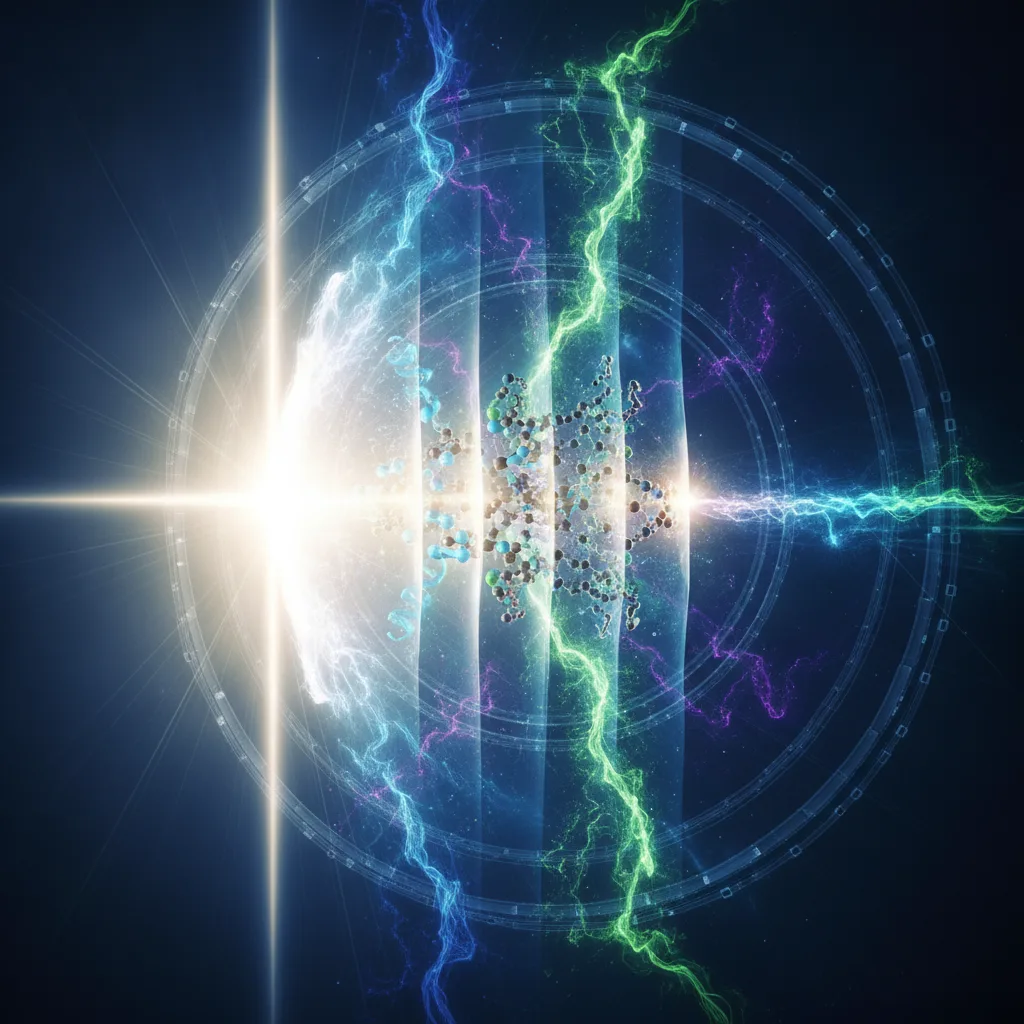
The universe of the infinitely small, where atoms and molecules dance in an ultrafast choreography, has remained largely invisible to the human eye, even with the most powerful microscopes. Until now. X-ray Free-Electron Lasers (XFELs) are the fastest "camera" in the world, capable of capturing snapshots of this invisible motion on femtosecond timescales – that is, quadrillionths of a second (10-15 s). To put it into perspective, a femtosecond is to a second what a second is to 32 million years.
These technological giants, such as the Linear Coherent Light Source (LCLS) in the US or the European XFEL in Germany, accelerate electrons to near the speed of light through a series of magnets, forcing them to emit coherent, extremely bright X-ray pulses. Each pulse is so short and intense that it can "photograph" chemical processes at the exact instant they occur, revealing how molecules change shape during a reaction or how functional proteins activate.
This capability has revolutionized fields from structural biology to materials science. For example, scientists can directly observe how an enzyme breaks a molecular bond or how light triggers the process of photosynthesis. The insights gained from XFELs are crucial for the development of new drugs, advanced materials, and a deeper understanding of the foundations of life itself, opening an unprecedented window into the secrets of matter at its most fundamental level.
Source: SLAC National Accelerator Laboratory (LCLS), European XFEL, Nature Photonics