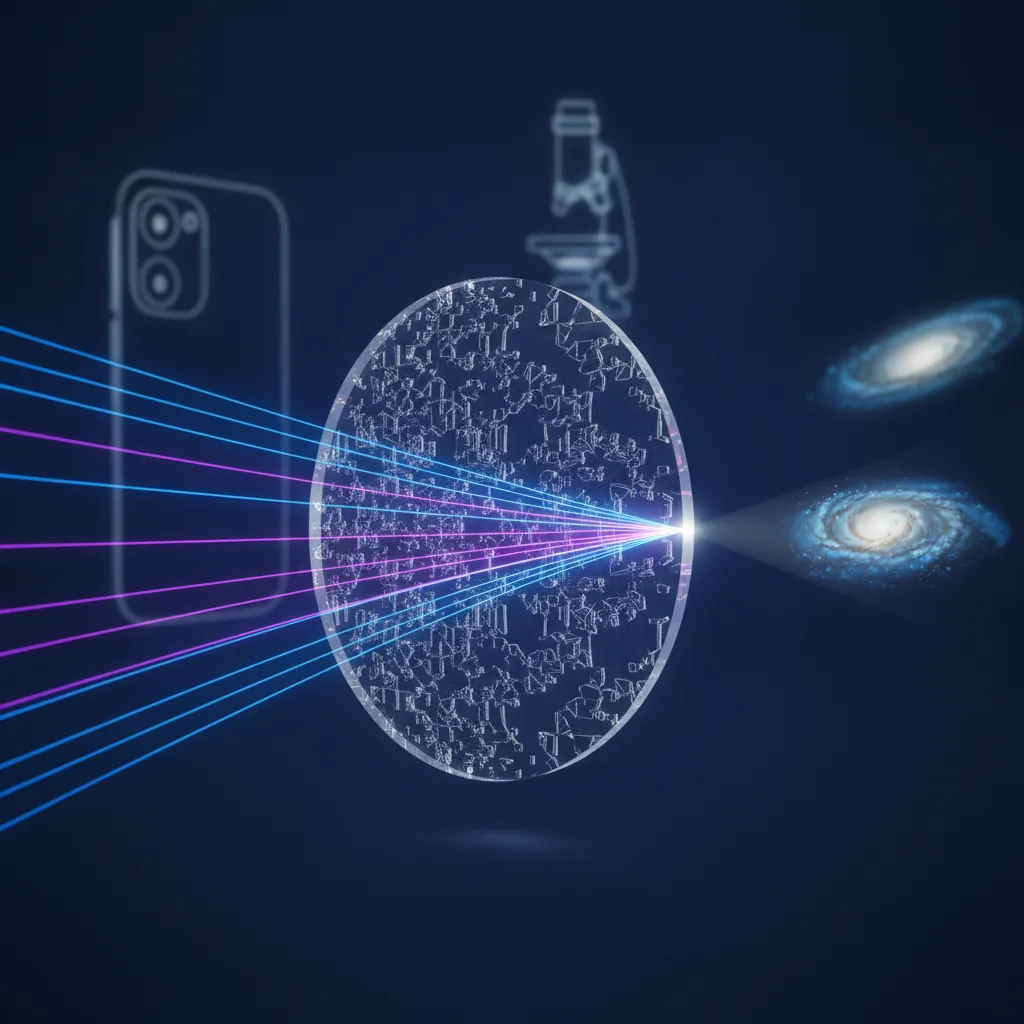
Imagine a lens that is not thick, curved, or heavy, but a thin flat sheet as thick as a human hair, capable of focusing light with astounding precision and seeing beyond what the human eye can perceive. This is the promise of optical metasurfaces, an emerging technology that is redefining the limits of modern optics.
Metasurfaces are essentially two-dimensional sheets adorned with a myriad of tiny nanostructures, such as pillars or grooves, arranged in precise patterns. Each of these nanostructures acts as a tiny antenna, individually manipulating the properties of light (phase, amplitude, and polarization) as it passes through them. This unprecedented control allows engineers to design lenses that are not only incredibly thin, but can also correct aberrations, polarize light, and even operate across light ranges spanning from infrared to ultraviolet.
The potential impact is enormous. From smartphone cameras with professional imaging capabilities to augmented and virtual reality devices offering wider, more realistic fields of view. They also promise to revolutionize medical sensors, night vision systems, and space telescopes, enabling more compact, efficient, and powerful tools. Research from institutions such as Harvard University and Caltech is driving this frontier, bringing us closer to a future where optical devices are radically different, smaller, and provide an expanded view of the world.
Source: Nature Photonics, Science, Harvard John A. Paulson School of Engineering and Applied Sciences