For centuries, naturalists and physicists wondered how geckos are able to run at full speed upside down across polished glass ceilings or hang from a wet leaf using a single limb. They do not have suction cups, they do not secrete adhesive substances, and they do not use mechanical claws. The enigma was unraveled in the early 2000s by biologist Kellar Autumn: geckos defy gravity by taking advantage of molecular interactions known as Van der Waals forces.
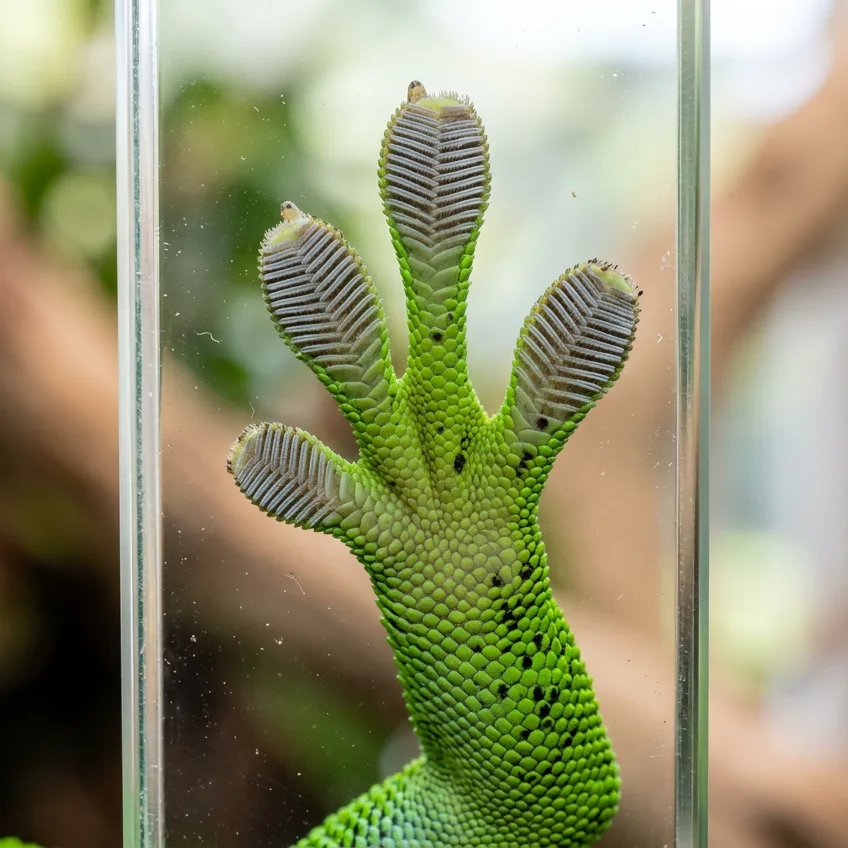
The secret lies in an astonishing anatomical hierarchy at the nanoscopic scale located on their toe pads:
- Microscopic setae: Each foot houses hundreds of thousands of tiny keratin filaments barely one hundred micrometers long.
- Nanoscopic spatulae: Each filament branches into up to one thousand even smaller flat endings, called spatulae, barely two hundred nanometers wide.
This extremely dense architecture allows millions of points to make intimate contact with any surface at a nanometric distance smaller than the diameter of an atom. At that level, spontaneous fluctuations in electron distribution generate transient electrostatic attractions. Although each bond is tiny individually, the coordinated action of nearly one billion spatulae produces a colossal adhesion capable of theoretically supporting more than 130 kilograms of weight.
To avoid getting stuck, the reptile modulates this force in just fifteen milliseconds by subtly altering the angle of inclination of its toes to more than thirty degrees, which breaks the molecular attraction instantly.
Source: Nature (Autumn et al., 2000: 'Adhesive force of a single gecko foot-hair') and Proceedings of the National Academy of Sciences (PNAS)