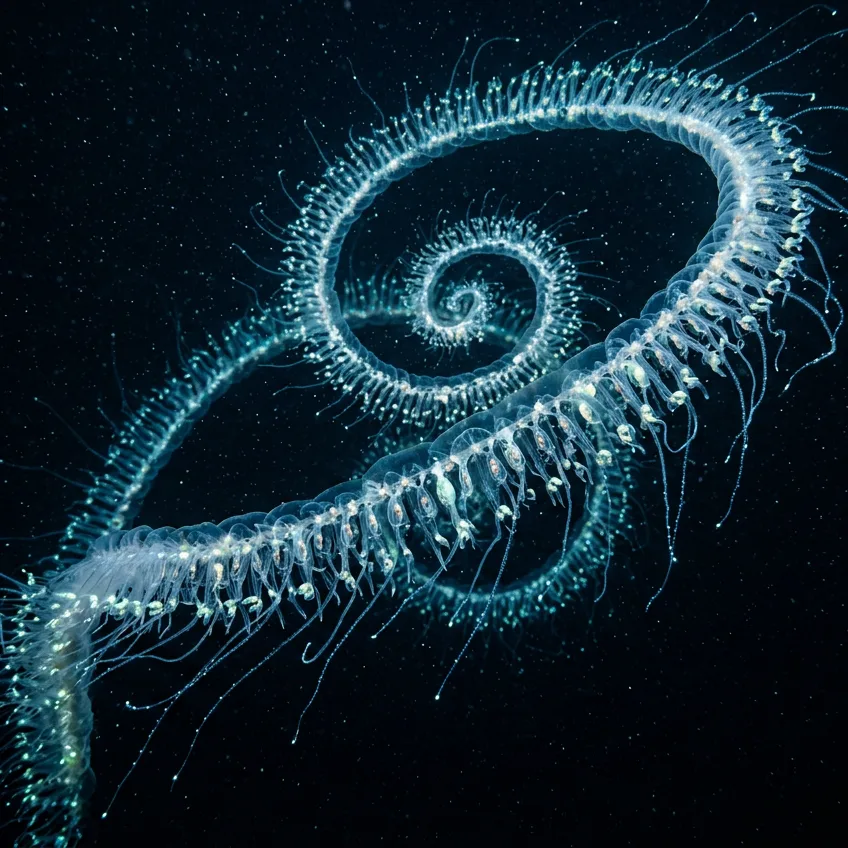
In the abyssal depths of the ocean, the longest living creature on the planet is neither a whale nor a giant squid, but a translucent, gelatinous organism that tests the biological definition of an individual: the giant siphonophore (especially of the genus Apolemia). In 2020, a scientific expedition in the Ningaloo submarine canyon, off the coast of Western Australia, spotted a specimen suspended in a hypnotic spiral whose outer ring measured about 47 meters in length, easily surpassing any known blue whale.
What is truly extraordinary about this organism is not only its monumental size, but its vital architecture. Although to the naked eye it moves and hunts like a single invertebrate, it is actually a colonial hydrozoan made up of millions of small interconnected bodies called zooids. They all share the exact same DNA because they arise through clonal budding from a single original fertilized egg, yet their morphology and function are radically distinct:
- Nectophores: act as coordinated hydraulic engines that rhythmically pulse water to propel the colony.
- Gastrozooids: make up the collective digestive system, absorbing nutrients that they then distribute through a shared central canal.
- Dactylozooids: long stinging filaments armed with lethal toxins responsible for paralyzing prey in the darkness.
- Gonozooids: units dedicated exclusively to the reproduction of the species.
None of these zooids can survive in isolation from the rest; they are so completely subordinated and connected that they have sacrificed their autonomy to operate as the living organs of a floating macroorganism, blurring forever the boundary between colony and animal.
Source: Schmidt Ocean Institute (2020) & Marine Biodiversity Records