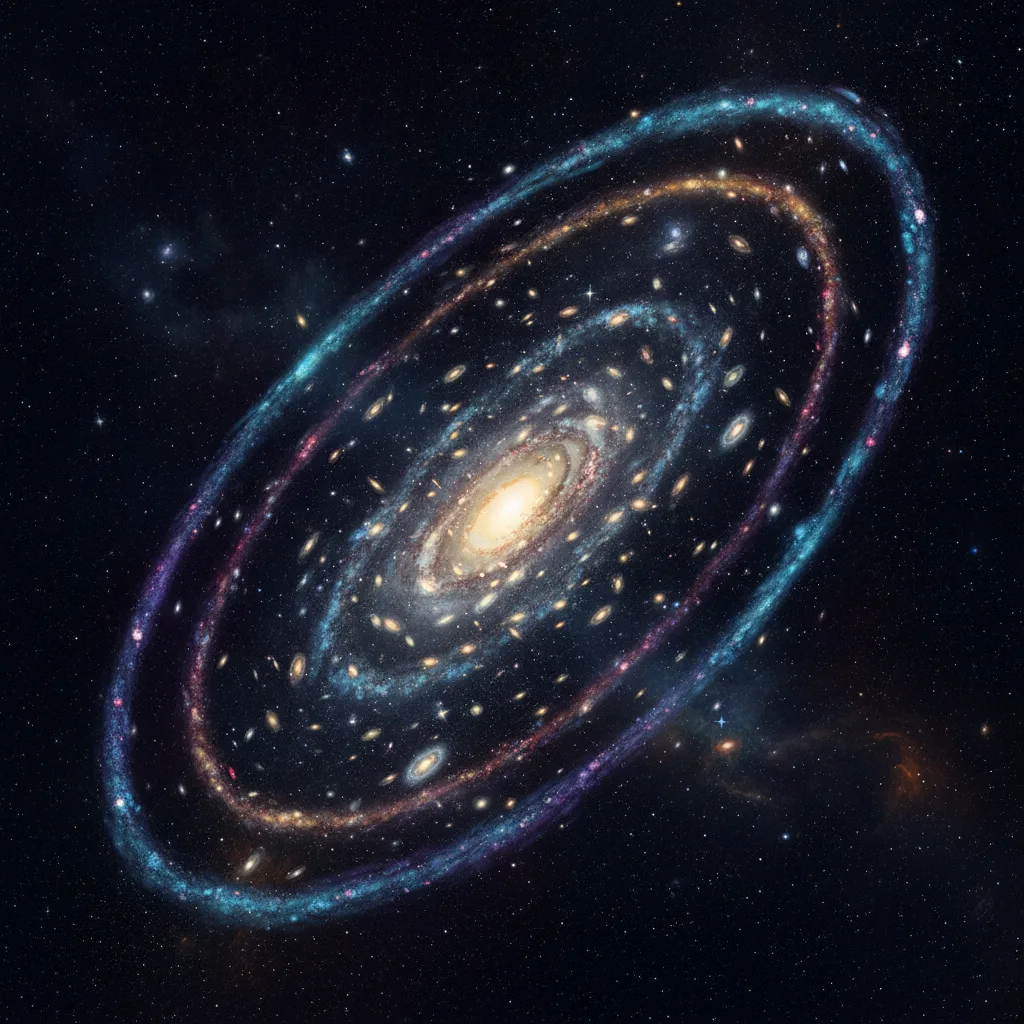
Imagine a telescope so vast that it spans billions of light-years, a natural observer that allows us to peer into the edges of cosmic time. This is not science fiction; it is the fascinating phenomenon of gravitational lenses. Predicted by Albert Einstein in his General Theory of Relativity, these "lenses" are not made of glass, but of colossal mass: entire galaxies, galaxy clusters, or even omnipresent dark matter.
When light from an extremely distant and faint galaxy travels across the universe, and a massive object (the "lens") stands in its path, its immense gravity curves spacetime itself around it. As a result, the path of light bends, acting similarly to an optical lens. This effect can magnify, distort, and sometimes even duplicate or triplicate the image of the background galaxy, revealing details that would otherwise be impossible to observe.
Astronomers use gravitational lenses as a fundamental tool. They allow us to study the first galaxies formed shortly after the Big Bang, whose light is extremely faint due to their distance and age. In addition, by analyzing how light is distorted, we can map the distribution of dark matter in galaxy clusters—that mysterious invisible substance that neither emits nor absorbs light, yet makes up 27% of the mass-energy of the universe. Without these cosmic lenses, much of our knowledge about the distant universe and dark matter would remain hidden.
Source: NASA, ESA, Caltech, Gemini Observatories, S. Allen (Stanford University)