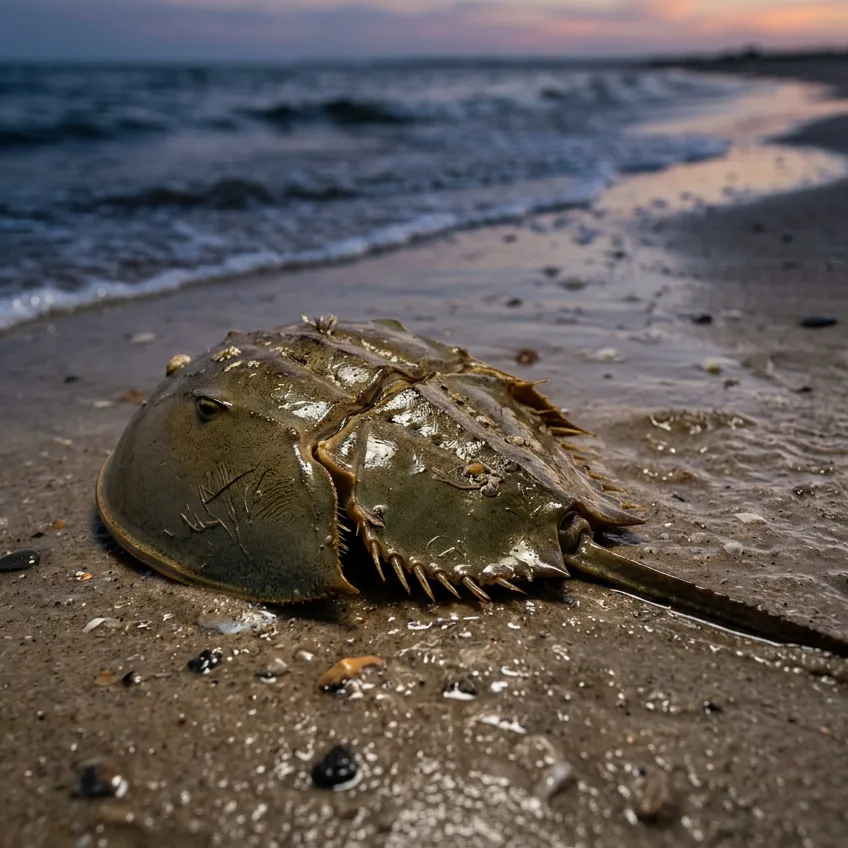
Long before the first dinosaurs walked the Earth, ancestors of the horseshoe crab (Limulus polyphemus) were already patrolling coastlines more than 450 million years ago. Although its appearance resembles an armored crustacean, taxonomically it is more closely related to spiders and scorpions. However, its most astonishing and valuable feature lies not in its shell, but inside it: its blood is a striking bright blue color due to the presence of hemocyanin, a copper-based rather than iron-based oxygen-transport protein.
Unlike vertebrates, this animal lacks an adaptive immune system with antibodies. To defend itself in marine waters packed with pathogens, it developed primitive immune cells called amebocytes. When these cells detect bacterial endotoxins—toxic components of Gram-negative bacterial cell walls—they release an enzyme cascade that clots the blood almost instantly, trapping the infection in an airtight gel.
This extraordinary chemical hypersensitivity was discovered in the 1950s by physician Frederik Bang, leading to the Limulus Amebocyte Lysate (LAL) test. This reagent revolutionized pharmacology:
- Extreme sensitivity: Detects bacterial contaminants at concentrations as low as one part per trillion.
- Global healthcare shield: Since the 1970s, global regulations have required testing every batch of vaccines, intravenous fluids, surgical prosthetics, and pacemakers with LAL before they are used in humans.
Thanks to this prehistoric creature that survived four mass extinctions, millions of medical procedures save lives every day free from bacterial sepsis.
Source: National Oceanic and Atmospheric Administration (NOAA) / Journal of Biological Chemistry (Frederik Bang, 1956)