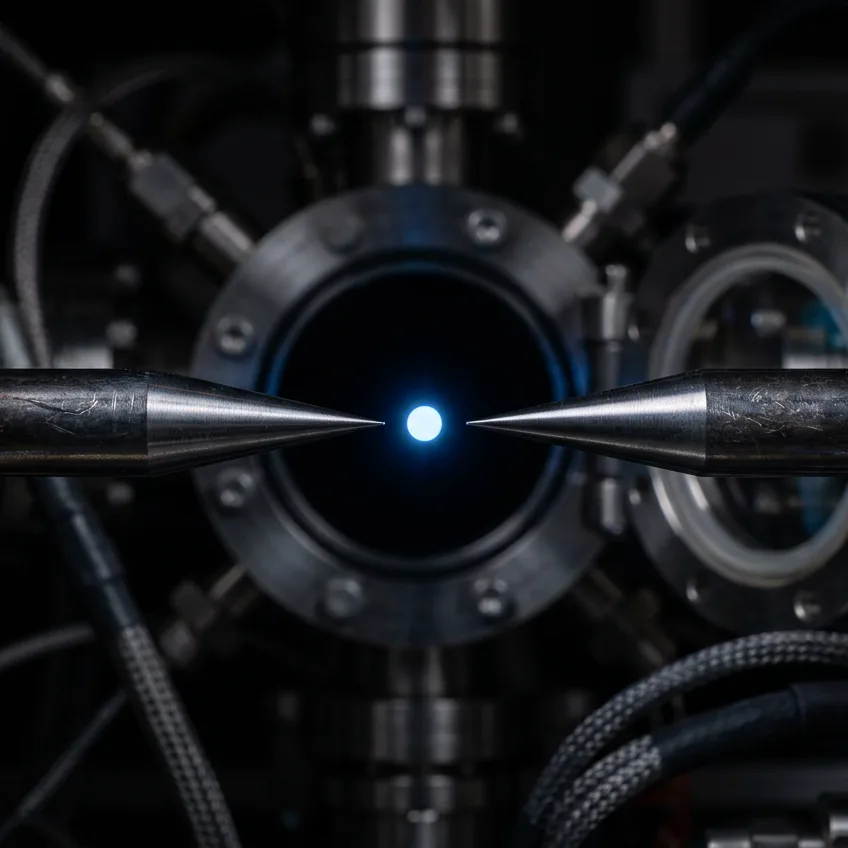
For decades, it was considered an immutable rule of applied physics: individual atoms are entities so tiny that it is impossible to observe them directly with visible light or photograph them with ordinary equipment. However, in February 2018, physicist David Nadlinger, from the University of Oxford, challenged this belief by capturing a historic image: a single strontium atom suspended in a vacuum, glowing as a tiny pale blue dot.
To make the invisible visible, researchers turned to a cutting-edge technique based on particle physics:
- The Paul ion trap: Inside an ultra-high vacuum chamber cooled to extreme temperatures, two metal needles separated by just two millimeters generated powerful oscillating electric fields that held the ionized atom motionless.
- Resonance excitation: A laser tuned to the exact blue-violet frequency bombarded the strontium ion. The atom absorbed and re-emitted photons at a frantic rate of hundreds of millions of times per second, acting like a tiny microscopic light bulb.
- Capture with a commercial sensor: Instead of using massive detectors or electron microscopes, Nadlinger used a conventional digital SLR camera with macro extension tubes and a long exposure of several seconds through the quartz window of the vacuum chamber.
Although the physical diameter of the atom is just a fraction of a nanometer, the light it scattered formed a diffraction pattern bright enough to excite the photographic sensor and be discernible by the human eye. Far from being a mere aesthetic curiosity, the control of individual ions in electromagnetic traps is the technological pillar that powers ultra-precise atomic clocks and next-generation quantum processors.
Source: University of Oxford / EPSRC (Engineering and Physical Sciences Research Council)