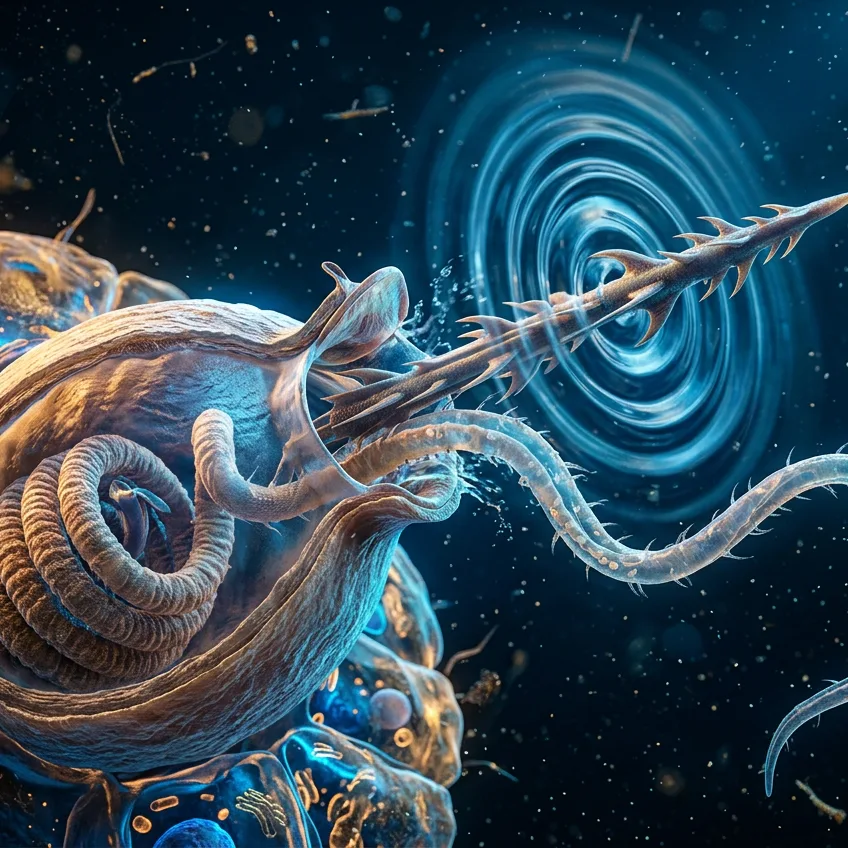
In the animal kingdom, the most devastating attacks do not always come from massive claws or crushing jaws, but from microscopic capsules housed in the tentacles of jellyfish, anemones, and corals. These are nematocysts, cellular organelles specialized in hunting and defense through the ballistic injection of lethal neurotoxins.
For decades, the exact speed of this discharge was an enigma due to technological limits. It was not until biophysicists from Heidelberg University used ultra-high-speed cameras operating at 1.4 million frames per second that the magnitude of the phenomenon was revealed: the microscopic stylet of the nematocyst is ejected in just 700 nanoseconds (less than a millionth of a second).
This burst produces a staggering acceleration that exceeds 5,400,000 g (five million times the force of Earth's gravity). For reference, a fighter pilot loses consciousness at around 9 g, and a rifle bullet barely reaches 40,000 g upon leaving the barrel.
The secret of this immense kinetic energy lies in an extreme osmotic mechanism:
- The capsule accumulates glutamate polymers and ions that generate an internal pressure of up to 150 atmospheres, equivalent to the weight of water at a depth of 1,500 meters.
- At the slightest tactile or chemical contact, an operculum opens and water rushes in, catapulting the tubular filament of the harpoon.
Despite its nanometer scale, the tip of the harpoon exerts a colossal pressure of several gigapascals at the point of impact, allowing it to effortlessly pierce the hard shells of marine crustaceans to inject its venomous cocktail in an imperceptible instant.
Source: Current Biology (Nüchter et al., 2006: 'Nanosecond-scale kinetics of nematocyst discharge')