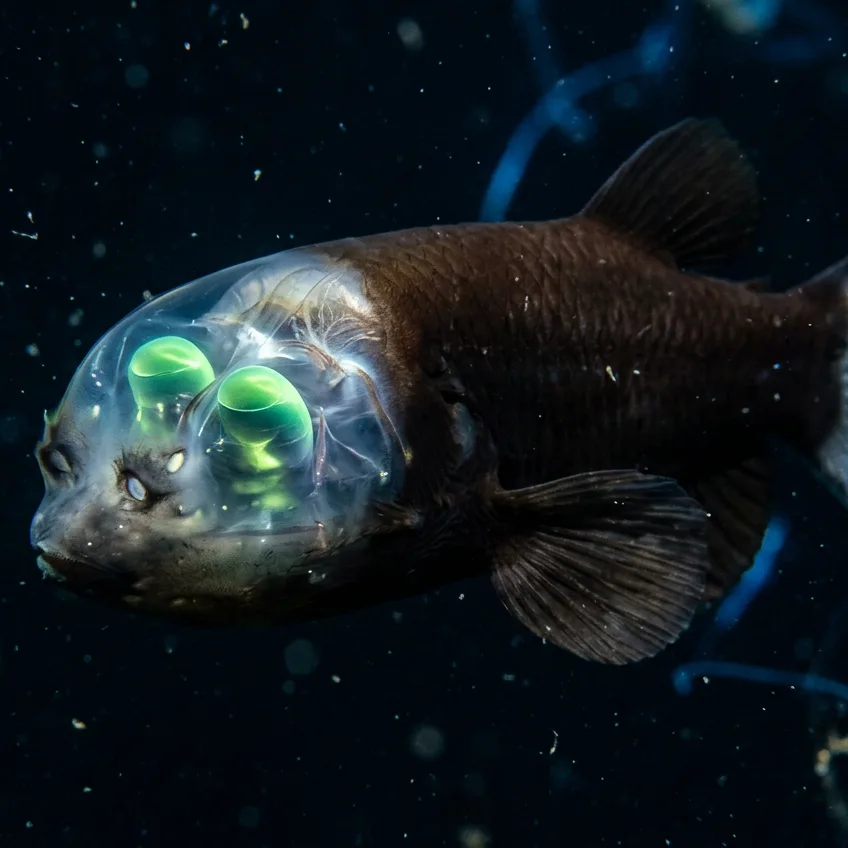
First described in 1939, the Pacific barreleye (Macropinna microstoma) puzzled ichthyologists for over half a century. Specimens caught in deep-sea fishing nets reached the surface with mutilated heads and two fixed cylindrical eyes gazing toward the zenith. Biologists assumed that this inhabitant of the mesopelagic zone had rigid and incomplete vision, unable to focus on what was in front of its mouth.
The mystery took a dramatic turn in 2004 thanks to high-resolution recordings by the Monterey Bay Aquarium Research Institute (MBARI). Observing the live fish at depths of more than 600 meters, scientists discovered that its head is covered by a translucent fluid-filled dome, a structure so delicate that conventional nets completely destroyed it before reaching the deck.
Beneath this protective shield lies one of the most unusual feats of optical engineering in the animal kingdom:
- False frontal eyes: The two small holes located above its small mouth, which look like eyes at first glance, are actually nares or hypersensitive olfactory organs.
- Rotating telescopes: Its true eyes are two enormous emerald cylinders submerged in cranial fluid. The animal can rotate them at will from a vertical position to track silhouettes to a horizontal position to coordinate the capture of prey.
- Biophotonic filter: The green pigment in its lenses filters out faint residual sunlight, allowing it to pinpoint the bioluminescent glow of siphonophores and copepods in total darkness.
This cephalic capsule not only optimizes its visual field, but also acts like a diving helmet that shields its eyes from venomous stings when stealing prey trapped in stinging tentacles.
Source: Monterey Bay Aquarium Research Institute (MBARI) / Marine Biodiversity Records (Robison & Reisenbichler, 2008)