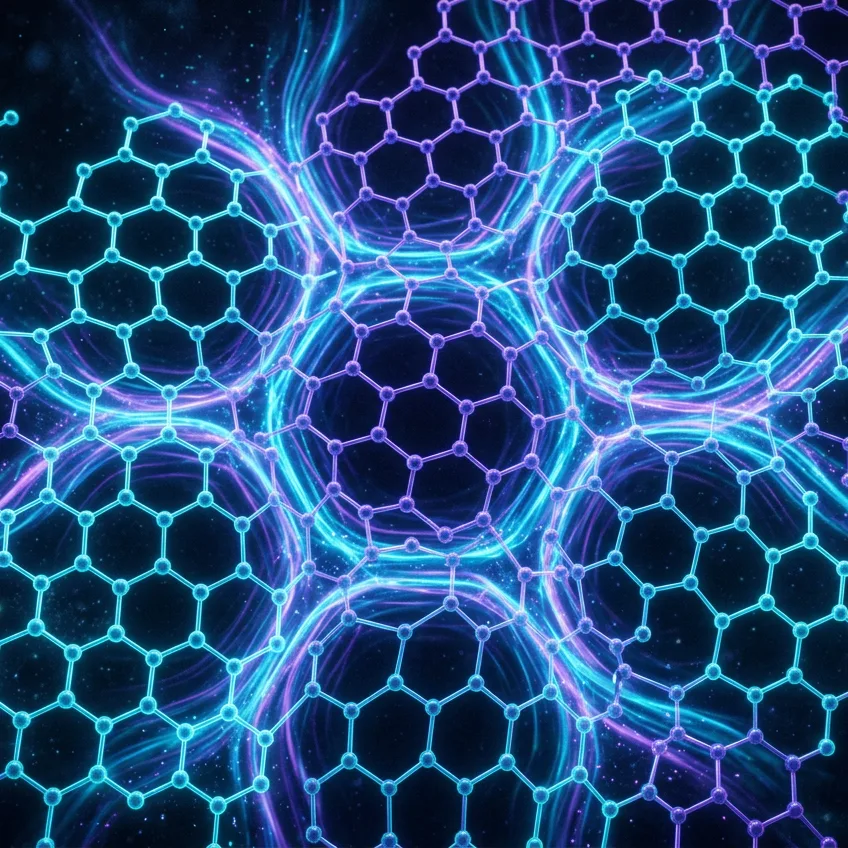
In 2018, a team from the Massachusetts Institute of Technology (MIT) led by Spanish physicist Pablo Jarillo-Herrero achieved a milestone that transformed condensed matter physics: they demonstrated that by stacking two sheets of graphene—each one atom of carbon thick—and rotating one of them by exactly 1.1 degrees relative to the other, their electronic properties change radically.
This precise angle, dubbed the magic angle, generates a nanoscale geometric interference known as a moiré pattern. At this exact tilt, electrons in the atomic lattice experience a drastic slowdown in their speed, causing them to stop ignoring each other and begin interacting with unusual intensity through quantum correlations.
The result is astonishing: with small adjustments in electrical voltage and at temperatures close to absolute zero, the material can switch from being a perfect insulator to a superconductor with zero electrical resistance, allowing current to flow indefinitely without losing energy as heat.
The finding not only confirmed theoretical predictions that seemed out of reach, but also inaugurated an entirely new scientific discipline: twistronics (from the word twist). Today, researchers manipulate the angle between multiple layers of various two-dimensional materials to simulate exotic quantum states, bringing humanity closer to the ultimate holy grail of modern physics: room-temperature superconductivity.
Source: Nature (Jarillo-Herrero et al., 2018 - 'Unconventional superconductivity in magic-angle graphene superlattices')