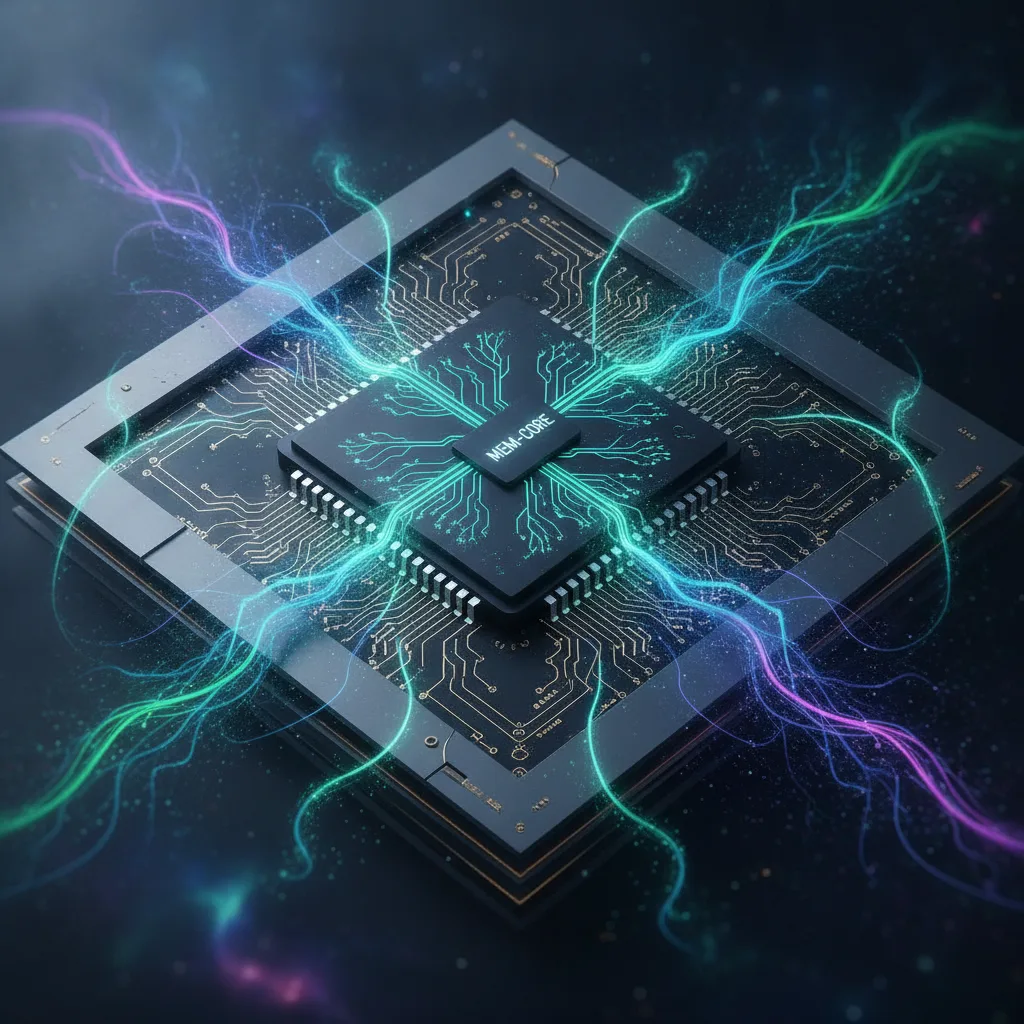
In the vast universe of electronics, there are four fundamental circuit elements: resistors, capacitors, inductors, and the most enigmatic of all, the memristor. Theoretically predicted by scientist Leon Chua in 1971, its physical existence was not confirmed until 2008 by HP Labs. The memristor, a portmanteau of "memory resistor," is a passive component whose electrical resistance is not constant, but depends on the history of the current that has flowed through it.
Unlike a traditional resistor, which offers fixed resistance, or RAM, which requires constant power to retain data, a memristor "remembers" the voltage or current that passed through it. This means it can store information without needing a continuous power supply, opening up a range of revolutionary possibilities.
Its ability to retain states and its function, similar to that of neural synapses, position it as the key building block for neuromorphic computing. Memristor-based chips could mimic the way the human brain processes and stores information, leading to far more efficient artificial intelligence capable of learning and adapting with much less power than current systems. Imagine devices that process data directly where it is stored, eliminating the "bottleneck" between CPU and memory. We are entering an era where electronics not only calculate, but also "remember" and "learn," challenging the limits of silicon as we know it.
Source: HP Labs, University of California Berkeley, Nature, IEEE Spectrum