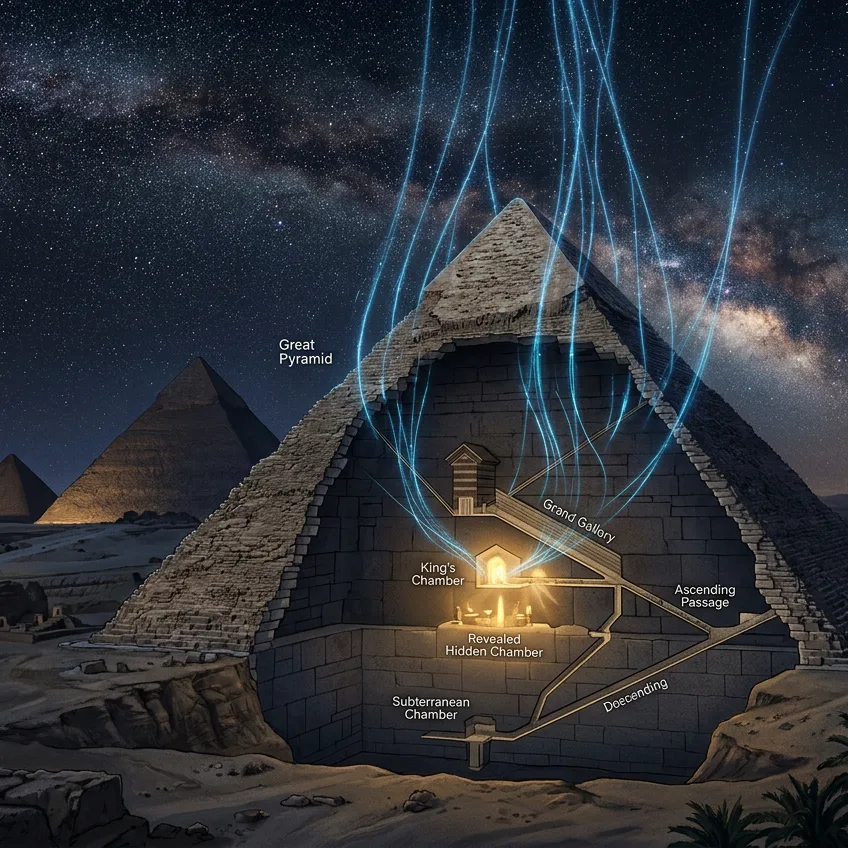
In 2017, the international scientific consortium ScanPyramids astonished the world by announcing the discovery of a secret cavity more than thirty meters long above the Grand Gallery of the Great Pyramid of Giza. The most fascinating part of the milestone was not only the archaeological find, but the noninvasive technology used to achieve it: muon tomography.
This technique works like an X-ray on a monumental scale that takes advantage of a natural astrophysical phenomenon:
- Subatomic shower: When cosmic rays originating from supernovas and distant galaxies collide with atoms in the upper atmosphere, they generate a steady cascade of elementary particles called muons.
- Penetrating power: Being about two hundred times heavier than electrons, muons travel at nearly the speed of light and can pass through hundreds of meters of solid rock before stopping.
- Density contrast: Limestone absorbs and scatters a predictable fraction of these particles, whereas air offers barely any resistance. By placing nuclear emulsion detectors inside and around the monument, physicists measured the muon 'shadow'; areas where more particles passed through revealed with mathematical precision the existence of a colossal hidden void.
Without moving a single block of the monument's six million tons, high-energy physics showed that the deep sky can be used as a geological scanner. Today, muon tomography is already being used to monitor magma chambers in active volcanoes and explore collapsed nuclear reactors.
Source: Nature (Morishima et al., 2017 - Discovery of a big void in Khufu's Pyramid by observation of cosmic-ray muons)