For more than a century, it was thought that neutrophils—the most abundant white blood cells in the bloodstream—fought infections solely by devouring microbes through phagocytosis or spraying them with toxins. However, in 2004, a team led by microbiologist Arturo Zychlinsky at the Max Planck Institute discovered a cellular strategy as extreme as it is cinematic: NETosis.
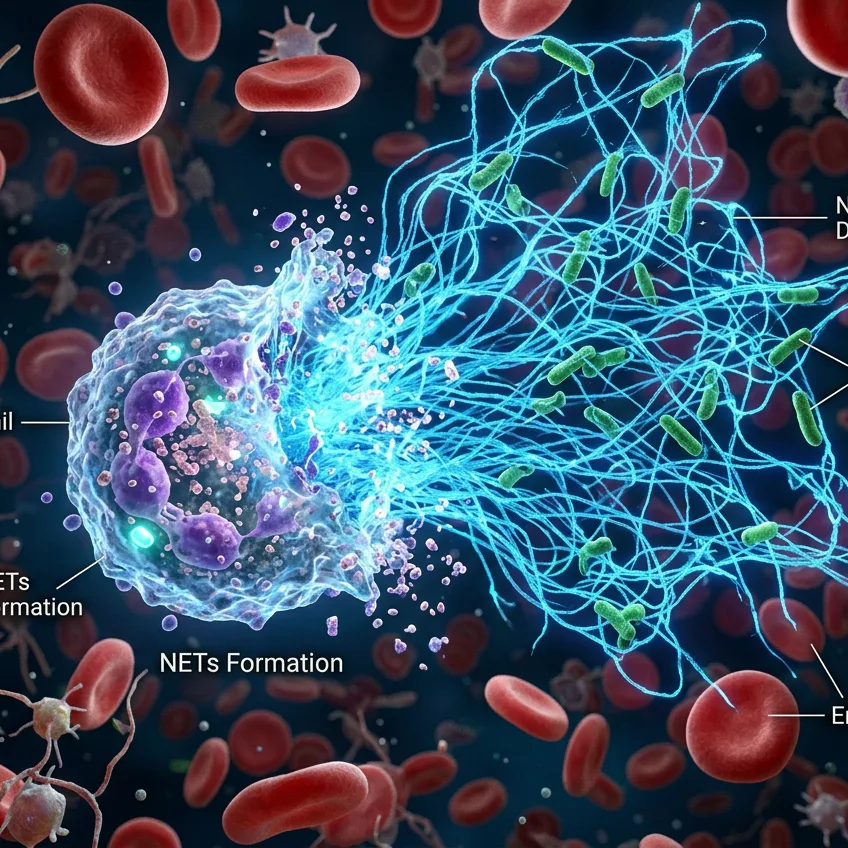
When these microscopic warriors face bacterial or fungal colonies too numerous or massive to be ingested, they activate a programmed form of altruistic suicide. In a coordinated process lasting just a few minutes, the cells deploy a lethal mechanism:
- Unpacking their genome: They unwind the dense chromatin in their nucleus and mix this DNA scaffold with devastating antimicrobial enzymes, such as myeloperoxidase and elastase.
- Detonating their membrane: They rupture their own cellular envelope, violently projecting elastic fibers of genetic material outward.
- Weaving the trap: They form what are known as Neutrophil Extracellular Traps (NETs), genuine molecular webs that physically immobilize pathogens and concentrate chemical venoms to eliminate them without dispersing them.
Despite being vital against sepsis, this bombardment has a dangerous edge: an excess of DNA nets in the blood damages surrounding tissues, clogs blood vessels by forming blood clots, and can trigger autoimmune disorders such as lupus.
Source: Max-Planck-Gesellschaft (Original research by Brinkmann et al., Science, 2004: 'Neutrophil Extracellular Traps Kill Bacteria')