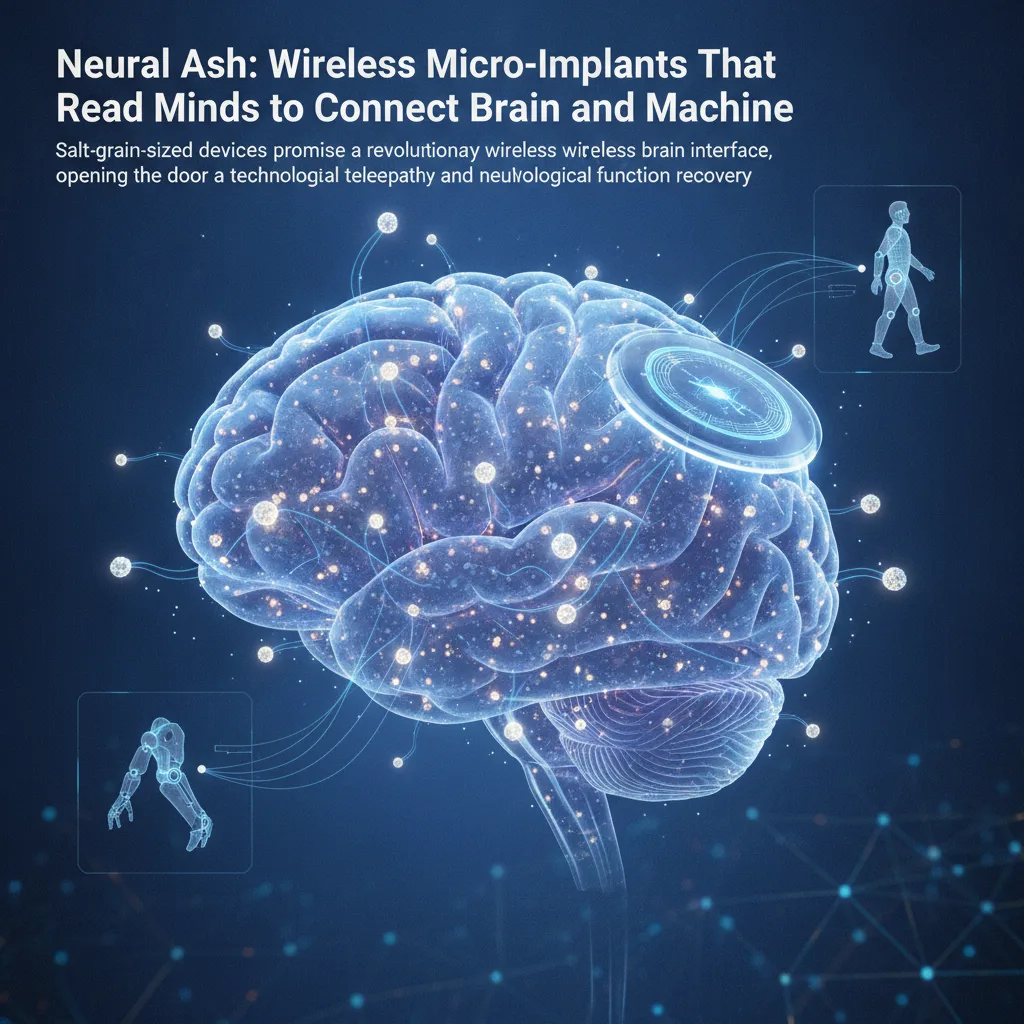
Imagine a future where our thoughts can directly control devices, without wires, without large intrusive implants. "Neural Dust" is a bold vision that seeks to make this a reality. These are wireless microdevices, the size of a dust particle or a grain of salt, designed to be implanted directly into the brain.
These tiny sensors, made from biocompatible materials, have the ability to record the electrical activity of individual neurons or small neuronal groups. Unlike current brain-computer interfaces (BCIs), which often require cables or bulkier implants, "Neural Dust" would operate completely wirelessly. Each "grain of dust" would be equipped with a miniature piezoelectric transducer, allowing ultrasonic energy to power them and read their data. This means that information from our brain could be transmitted to an external receiver without the need for batteries or direct physical connections.
The potential of this technology is immense. It could allow people with paralysis to move advanced prosthetics with their thoughts, restore lost sensory functions, or even enable direct "telepathic" communication between brains and machines. Although it is still in experimental stages, with cutting-edge research at universities such as the University of California, Berkeley, it represents a quantum leap toward the human-computer interaction of the future, transforming neuroscience and medicine.
Source: University of California, Berkeley - Neural Dust research; Nature Biomedical Engineering.