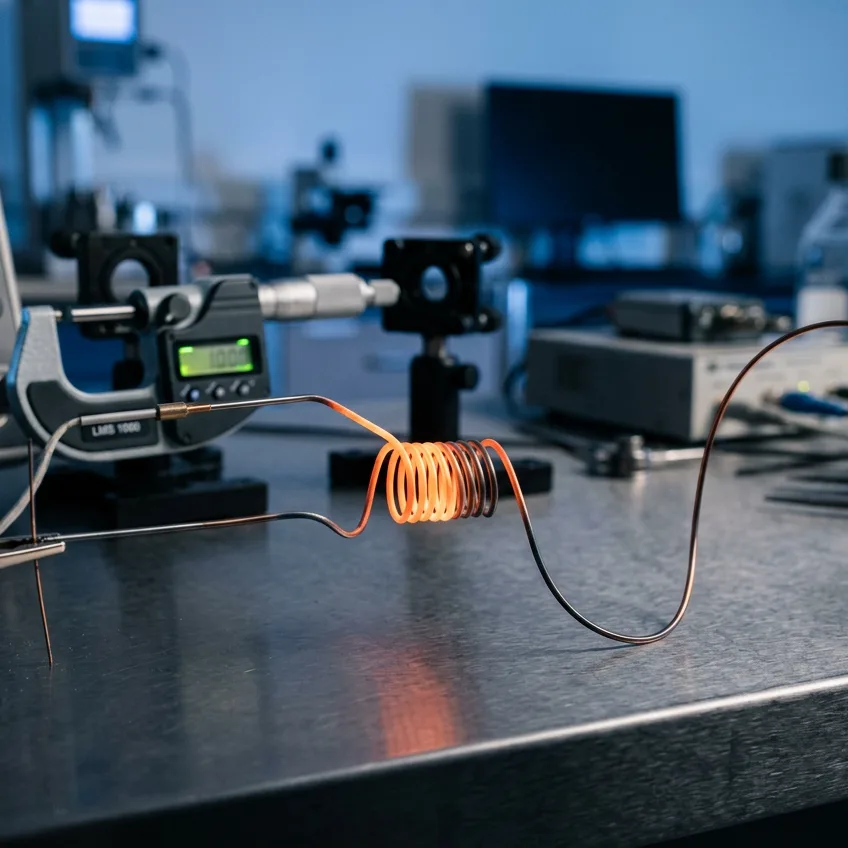
In the late 1950s, metallurgist William J. Buehler was searching at the U.S. Naval Ordnance Laboratory (NOL) for an alloy resistant to corrosion and extreme temperatures for ballistic missile nose cones. While experimenting with an exact ratio of nickel and titanium, he noticed puzzling acoustic behavior: striking a cold bar produced a dull thud, but when warm, it rang like a crystal bell.
The true marvel was revealed in 1961 during a technical meeting. A strip that had been folded repeatedly was exposed to the flame of an attendee's pipe lighter; to everyone's astonishment, the metal instantly straightened out and returned to its original flat shape on its own. Nitinol (an acronym for Nickel Titanium Naval Ordnance Laboratory) was born.
The key to this apparent magic lies in a solid-state phase transformation without altering mass:
- Martensitic phase (low temperature): Its crystal structure is flexible and can deform mechanically without breaking atomic bonds.
- Austenitic phase (high temperature): When heat is applied, the atoms snap into a rigid, highly ordered cubic lattice.
Unlike common wire, which undergoes irreversible plastic deformation, Nitinol memorizes its original crystal position. Today, this property is used not only in robotics and space satellites, but also in medicine: cardiovascular stents travel microscopically compressed through arteries and expand with millimeter precision once they reach human body temperature.
Source: Naval Surface Warfare Center / Nature Materials