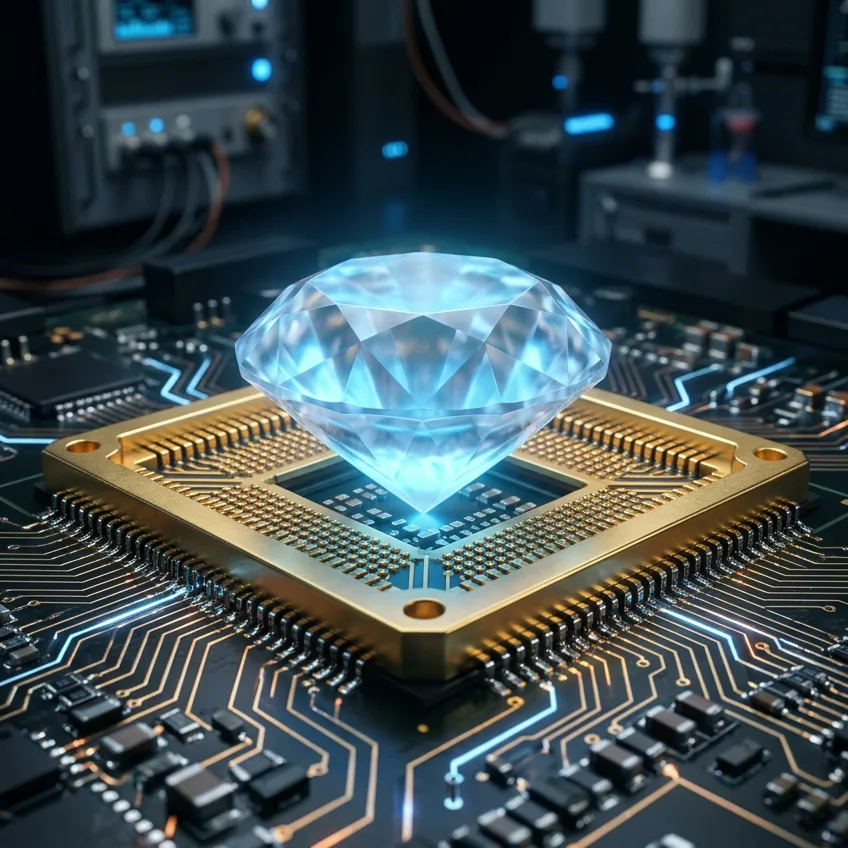
Is it possible to transform tons of hazardous radioactive waste into an endless source of clean energy? In 2016, a team of physicists and chemists from the University of Bristol presented a revolutionary solution: synthetic diamond betavoltaic batteries, capable of generating continuous electricity for millennia without needing recharging or maintenance.
The core of this innovation lies in carbon-14, a radioactive isotope accumulated in the graphite blocks used to moderate decommissioned nuclear reactors. When this material is heated, most of the carbon-14 vaporizes into gas. Through a chemical vapor deposition process, researchers capture this gas to forge an artificial radioactive diamond.
The mechanism is as ingenious as it is safe:
- Continuous generation: The carbon-14 emits beta particles (high-speed electrons) that, upon colliding with the crystal structure of the diamond semiconductor, release additional electrons and generate a stable electrical current.
- Impenetrable shielding: The radioactive core is encapsulated inside a second layer of pure, non-radioactive diamond. Being the hardest known substance, it fully contains the beta emissions, making the device completely safe for human contact.
Since the half-life of carbon-14 is 5,730 years, these microbatteries would take more than 28,000 years to lose half of their initial power. Although they supply small currents (on the order of microwatts), they represent an ideal solution for powering pacemakers that would never need replacement, deep-space probes, or sensors in oceanic trenches.
Source: University of Bristol (Cabot Institute for the Environment)