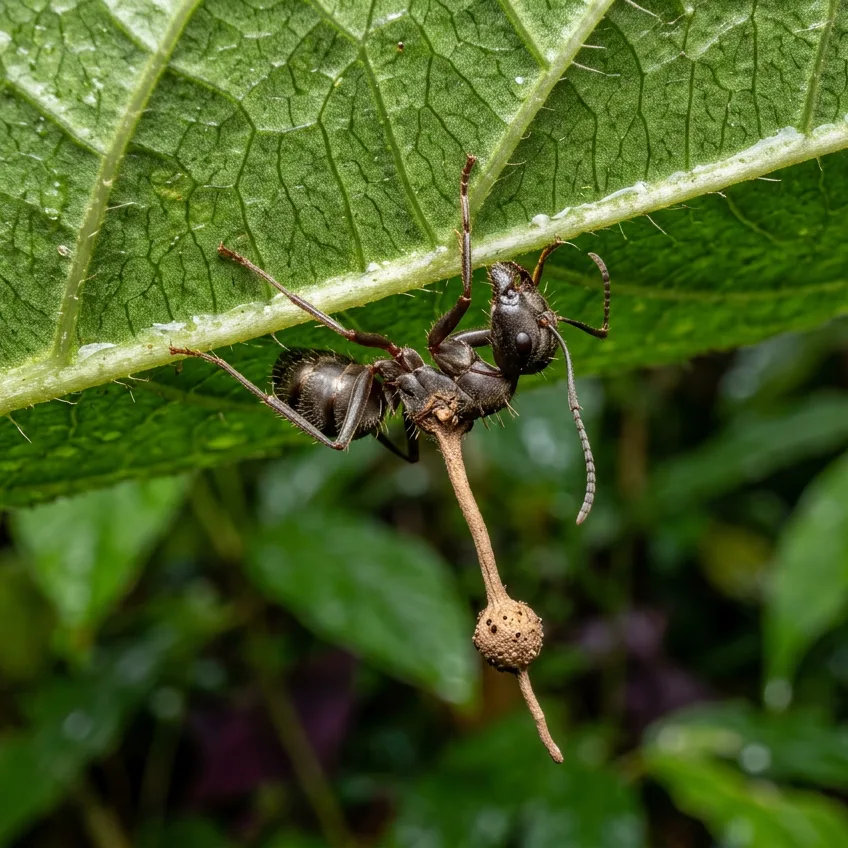
For decades, science assumed that fungi of the genus Ophiocordyceps took control of carpenter ants by colonizing and devouring their brains to alter their behavior. However, groundbreaking research from Pennsylvania State University published in PNAS revealed an even more disturbing reality: the victim's brain remains intact while its body is hijacked from the inside.
Using three-dimensional electron microscopy and machine learning algorithms, biologists reconstructed the bodies of infected ants at the cellular level. They discovered that fungal cells proliferate massively, fusing together to create an interconnected biological network that penetrates and envelops each muscle fiber.
- Neuromuscular hijacking: The fungus acts as a cellular puppeteer, directly manipulating muscle contractions through local chemical signals.
- The death grip: It forces the ant to climb a leaf at exactly 25 centimeters above the ground—the height with optimal humidity and temperature for the fungus—and locks its jaws onto the central vein before killing it.
- An imprisoned brain: Samples showed that brain tissues lacked fungal cells, suggesting that the central nervous system remains isolated and conscious while the fungus mechanically pilots its limbs.
This finding redefines modern parasitology: the parasite does not need to reprogram the insect's central computer if it can directly hack the engines that move its parts.
Source: Proceedings of the National Academy of Sciences (PNAS) - 'Three-dimensional in situ imaging of host-parasite dynamic interactions'