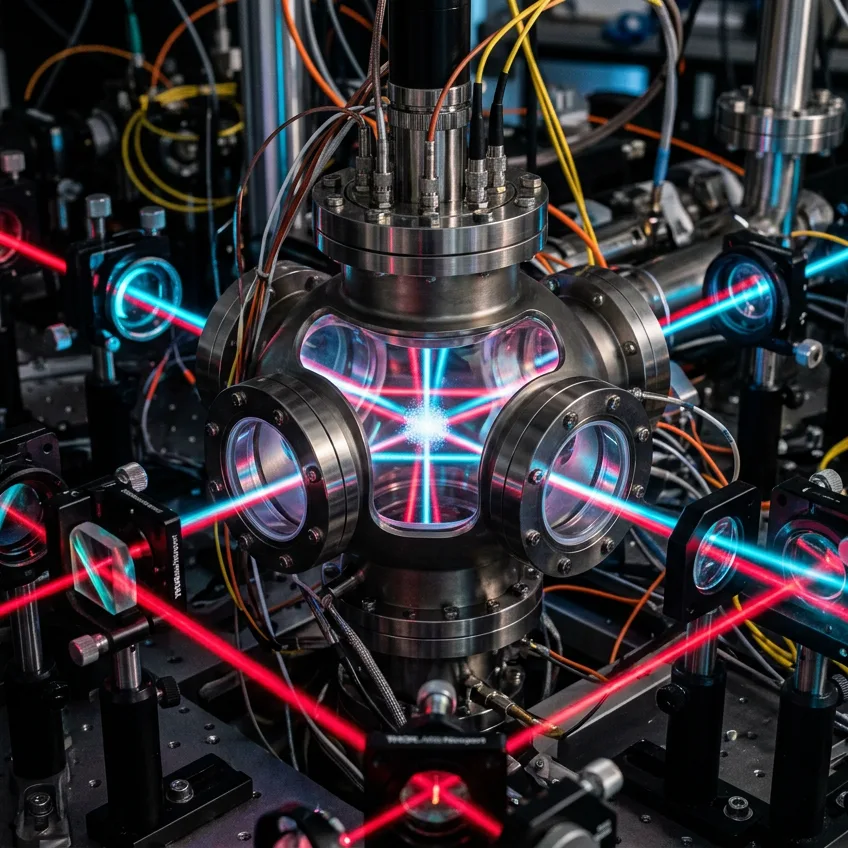
According to Albert Einstein's theory of general relativity, time passes more slowly the closer you are to a massive gravitational field. For decades, testing this phenomenon required comparing atomic clocks placed atop mountains against others at sea level, or checking signals against space satellites. However, in 2022, physicists from the JILA institute and NIST in the United States achieved an unprecedented feat: measuring time dilation across an altitude difference of just one millimeter.
To achieve this, the scientists used an optical lattice clock based on about 100,000 strontium atoms cooled to fractions of a degree above absolute zero. These atoms are confined within a three-dimensional grid created by laser beams, which prevents collisions and interference. By examining the energy transitions between quantum states, the instrument reaches such colossal precision that it would only lose a second every 300,000 million years, a span of time far exceeding the current age of the universe.
By dividing the small sample of atomic gas into vertical segments, the team detected a minuscule gravitational redshift: the atoms positioned just one millimeter higher registered a slightly faster rate of time due to the subtle reduction in Earth's gravitational pull. This extreme precision has revolutionary applications beyond pure timekeeping:
- Relativistic geodesy: Detection of millimeter-scale changes in ground elevation caused by magma or groundwater.
- Physical exploration: Searching for dark matter particles and low-frequency gravitational waves.
- New definition of the second: The official redefinition of the unit of time in the International System of Units.
Source: National Institute of Standards and Technology (NIST) / Nature (Bothwell et al., 2022)