In the depths of the ocean lives an organism with one of the most disturbing and fascinating parasitic adaptations in nature: Cymothoa exigua. This marine isopod crustacean holds an absolute biological record: it is the only known parasite on the planet capable of functionally replacing an entire organ of its host.
The cycle begins when the parasite, in its juvenile phase, slips through the gills of fish such as the spotted rose snapper (Lutjanus guttatus). Once inside the oral cavity, if it matures as a female, it climbs toward the base of the tongue and hooks its 7 pairs of legs with sharp claws into the main artery. By cutting off blood flow, it triggers severe ischemia: the fish's tongue atrophies, becomes necrotic, and eventually falls off entirely.
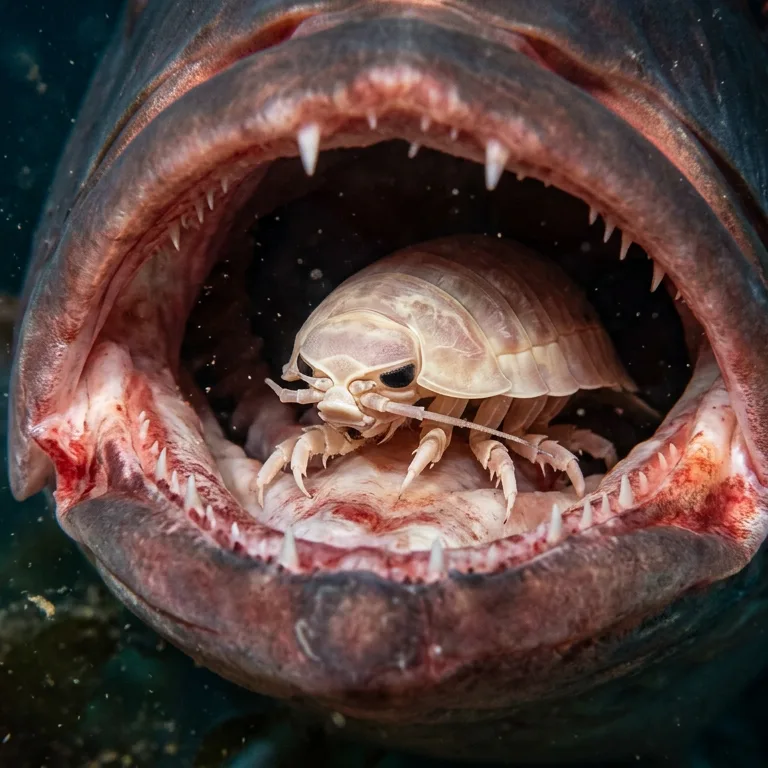
However, the loss of the tongue does not kill the host or dislodge the invader. The crustacean anchors itself firmly to the remaining muscular stub and takes on the role of the removed tissue. From that point on:
- The fish uses the body of the crustacean as a biological replacement tongue to swallow and handle prey.
- The isopod does not consume the fish completely; it survives by feeding on excess oral mucus and food scraps.
- Both organisms can coexist for years, functioning mechanically as a biomechanical system without the fish starving to death.
This unusual balance between mutilation and a living prosthesis turns Cymothoa exigua into one of the greatest evolutionary oddities in the animal kingdom.
Source: Journal of Fish Biology