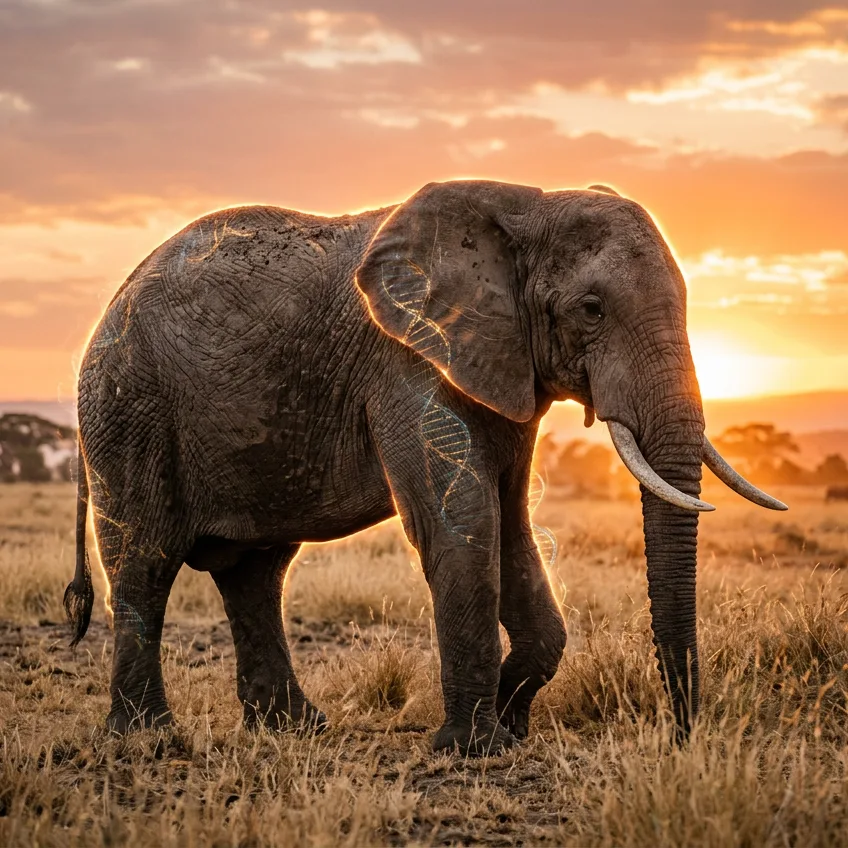
Logically, an animal with trillions more cells than a human and a similar life expectancy should have an astronomical probability of developing malignant tumors. In the 1970s, epidemiologist Richard Peto discovered that tumor incidence does not correlate with body mass or longevity across different species: a contradiction known as Peto's Paradox.
The answer to this enigma remained hidden until detailed genomic analyses revealed the evolutionary secret of African and Asian elephants: an extraordinary molecular arsenal centered on the TP53 gene, commonly nicknamed "the guardian of the genome." While humans possess only two alleles of this crucial gene (one inherited from each parent), elephants have forty copies distributed across twenty chromosomal pairs.
The TP53 gene encodes the p53 protein, which is responsible for patrolling and detecting breaks in cellular DNA. When a human cell suffers genetic damage, p53 attempts to repair it before it divides; if the damage is excessive, it induces apoptosis, or programmed cell death. In elephants, however, the massive concentration of p53 wastes no time on intermediate repairs: it immediately triggers a swift purge that destroys the damaged cell before it can mutate.
Added to this armor is the discovery of the LIF6 gene, a "zombie pseudogene" that proboscideans evolutionarily resurrected, which pierces the mitochondria of precancerous cells to destroy them from within. Thanks to this dual biological barrier, the cancer mortality rate in elephants does not exceed 5%, compared to more than 20% recorded in our own species.
Source: Journal of the American Medical Association (JAMA) / Cell Reports