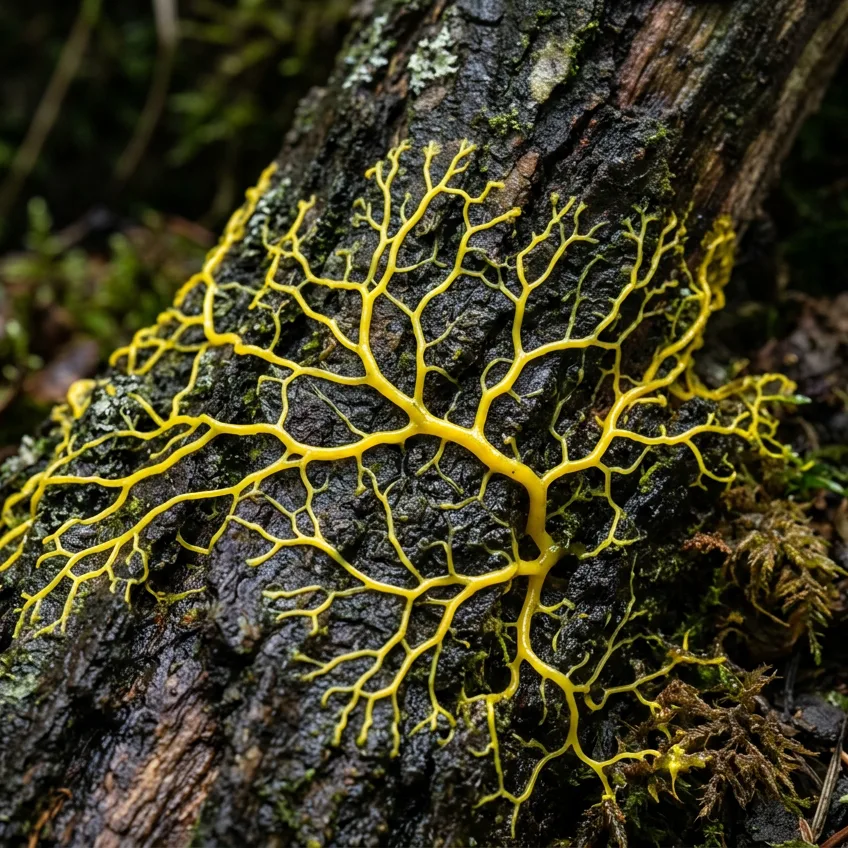
Popularly known as "the blob," Physarum polycephalum is a slime mold that challenges the traditional boundaries between intelligence and elemental neurobiology. Despite being a single gigantic macroscopic cell containing millions of nuclei without membrane divisions, this astounding organism exhibits computing and spatial optimization capabilities without having a single neuron.
The secret of its processing lies in its pulsatile cytoplasm. The slime mold's gelatinous mass generates rhythmic actomyosin contractions through a dense network of internal tubules. When the tips detect nutrients (such as bacteria or oat flakes), the channels leading to the source widen due to increased flow, while inactive pathways wither and disappear, always finding the most economical route.
Scientific research has revealed baffling feats in this single-celled being:
- Maze solving: In 2000, biophysicists from Hokkaido University placed pieces of food at the entrance and exit of a maze; the slime mold eliminated all dead ends and connected both points along the mathematically shortest route.
- Infrastructure design: In 2010, a trial published in Science replicated the geographic map of Tokyo by placing oat flakes on the surrounding cities; in 26 hours, the slime mold generated a layout identical to, and with the same fault tolerance as, the Japanese rail network designed by engineers over decades.
- Memory without a nervous system: It is capable of remembering periodic unfavorable stimuli, such as scheduled pulses of cold and dryness, slowing its advance in advance at the exact minute the next blast was due, even if scientists canceled the shock.
Source: Tero, A. et al. (2010). 'Rules for Biologically Inspired Adaptive Network Design'. Science, 327(5964), 439-442.