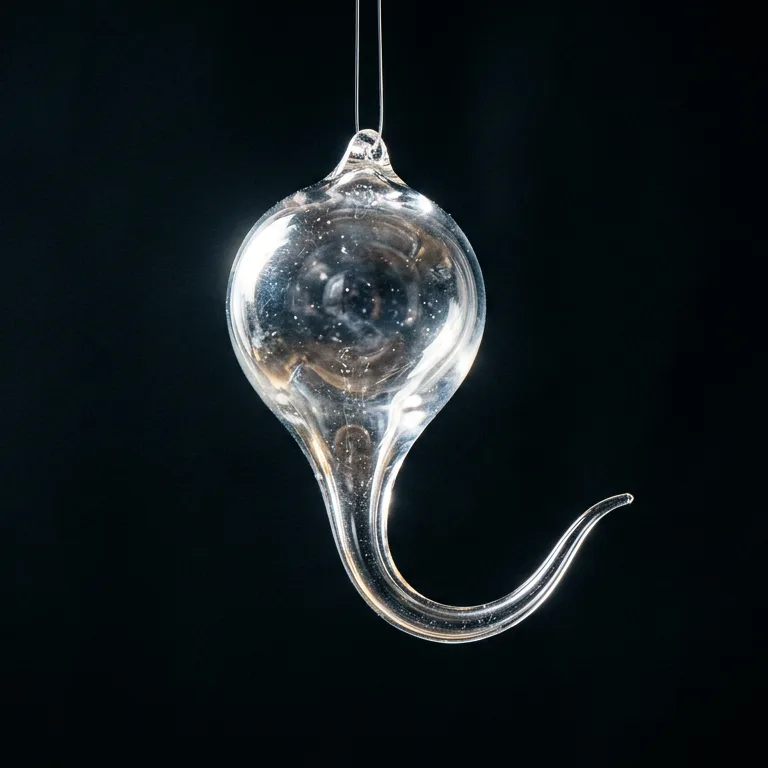
In the 17th century, diplomats and members of European royalty were fascinated by a physical curiosity named Prince Rupert's drops or Dutch tears. These small glass figures, formed by dropping molten glass beads into a container of cold water, exhibit an apparently contradictory mechanical behavior: their rounded head can resist hammer blows and even shatter rifle bullets, but if the fragile tail is broken, the entire piece instantly disintegrates into a cloud of microscopic powder.
The secret to this supernatural strength lies in the residual mechanical stresses caused by thermal shock:
- Extreme surface compression: Upon touching the water, the outer layer of the glass cools and solidifies in milliseconds, while the core remains incandescent and pliable.
- Internal tensile stress: When the center finally cools and contracts, it pulls inward on the rigid shell, locking the surface under compressive pressures exceeding 700 megapascals (more than 7,000 times atmospheric pressure).
To break the rounded head, an external force must first overcome that gigantic compressive force that seals any microfracture. However, in the thin tail, the core in tension is left nearly unprotected. When it is cut or scratched sufficiently, a fracture shockwave is released that travels through the inside of the glass at more than 1,600 meters per second (more than four times the speed of sound), detonating the structure. This physical principle is the foundation of modern tempered glass that protects screens and cars.
Source: Applied Physics Letters (American Institute of Physics) - 'Stress distribution and explosive fragmentation in Prince Rupert's drops'