Under extremely pure conditions, liquid water can remain unfrozen down to about -38 °C, a state known as supercooling that requires a seed particle or "nucleation core" for molecules to form ice crystals. Surprisingly, nature's most efficient ice catalyst is not an inorganic mineral, but a living microorganism: the bacterium Pseudomonas syringae.
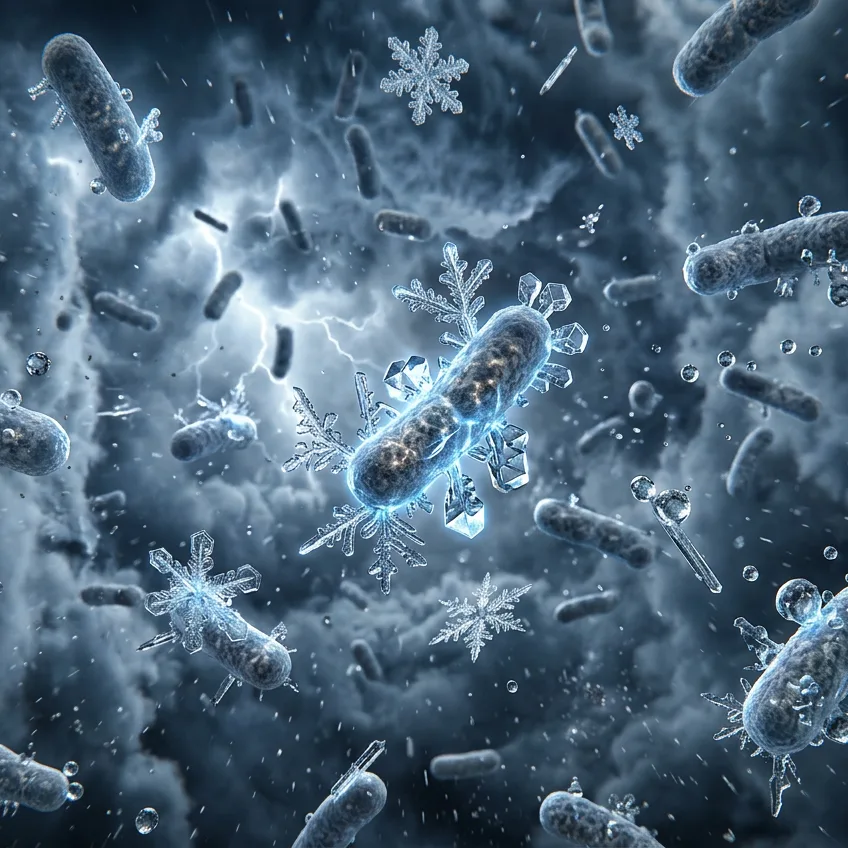
This plant bacterium possesses a unique protein called InaZ on its outer membrane. Its molecular structure repeats an amino acid pattern with spacing identical to the crystal lattice of ice, forcing surrounding water molecules to align into a solid geometry almost instantaneously at temperatures as warm as -1.8 °C.
The evolution behind this trick is devastatingly clever:
- Tissue rupture: By inducing premature frost on leaves, expanding ice crystals break the cell walls of the host plant, releasing sap and nutrients that the bacterial colony feeds on immediately.
- Bioprecipitation: Thermal updrafts lift millions of these bacteria into the troposphere. Once suspended in clouds, they act as potent biological ice nuclei, triggering snowfalls and rainstorms that carry them back to the ground onto new, fertile crops.
Today, this mechanism is so reliable that the ski industry uses commercially available inactivated strains of P. syringae to produce artificial snow at temperatures where atomized water would never freeze on its own.
Source: Nature Reviews Microbiology / PNAS (Proceedings of the National Academy of Sciences)