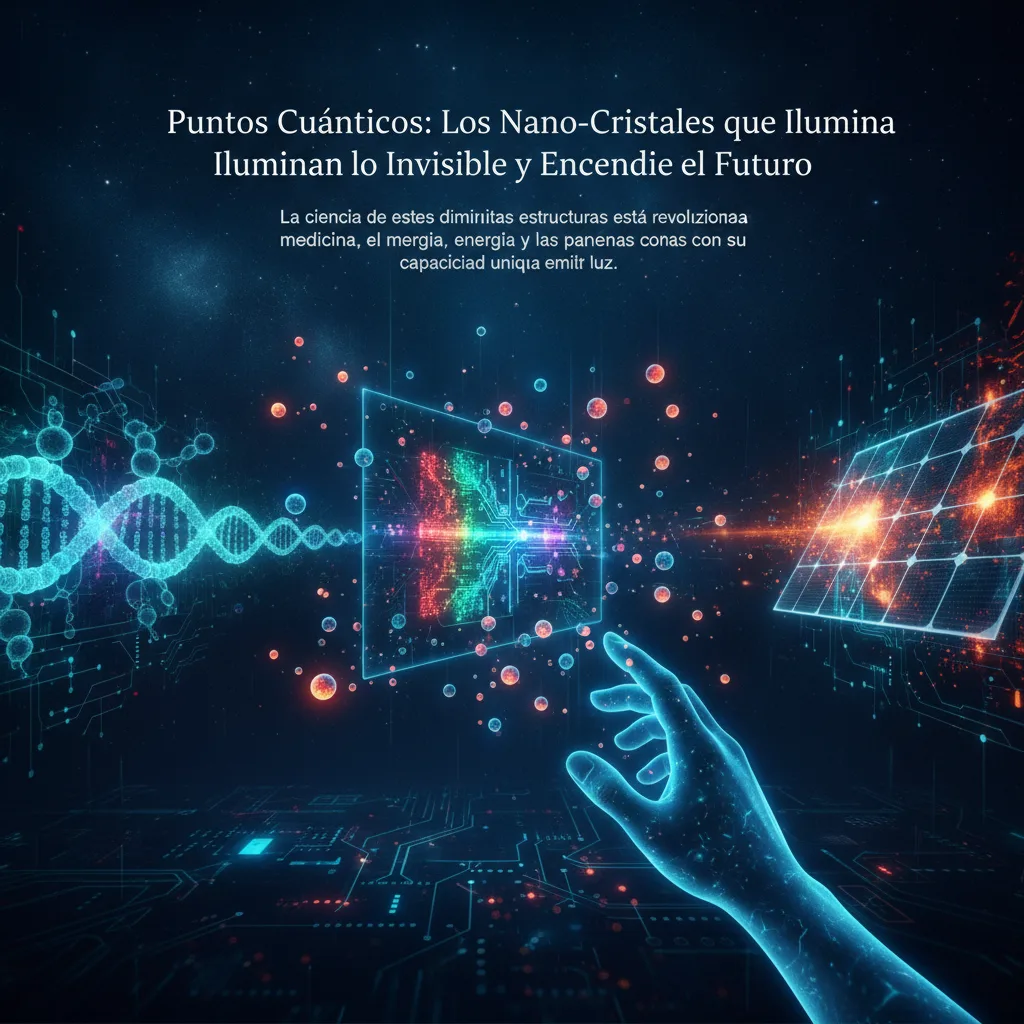
Imagine crystals so small that their size determines the color of the light they emit. These are Quantum Dots (QDs), semiconductor nanocrystals measuring just a few nanometers, thousands of times smaller than the width of a human hair! Their uniqueness lies in a phenomenon known as "quantum confinement": at these tiny scales, the laws of classical physics blur, and the light particles (photons) they absorb and emit are directly influenced by their size. A larger quantum dot will emit red light, while a smaller one will glow blue or green.
Discovered in the 1980s and awarded the Nobel Prize in Chemistry in 2023, quantum dots have opened up a range of revolutionary applications. In medicine, they act as ultra-bright, stable fluorescent tags, capable of illuminating cancer cells with unprecedented precision or tracking drug delivery in real time, surpassing traditional dyes in visibility and lifespan.
In the field of technology, they are transforming our displays. QLED televisions use quantum dots to produce purer, more vibrant, and energy-efficient colors. In addition, their potential extends to next-generation solar cells, capable of converting sunlight into electricity with greater efficiency, and even to quantum computing, where they could function as qubits (the basic unit of quantum information). These tiny giants are laying the groundwork for a new era of discoveries, bringing light to corners of science and technology that were once invisible.
Source: NobelPrize.org, Nature Nanotechnology, Science