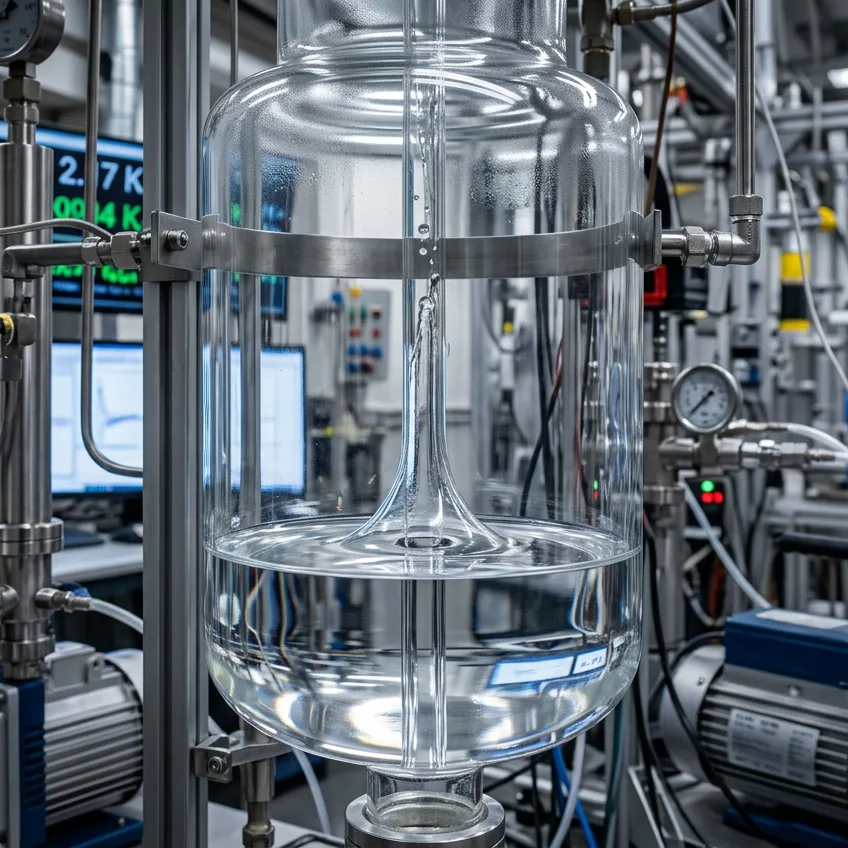
Imagine a liquid so extraordinary that it flows with zero resistance, climbs the walls of its container, and even defies gravity, becoming the only known material with such extreme properties: superfluid helium.
This astonishing state of matter is reached when the helium-4 isotope is cooled to extremely low temperatures, below 2.17 Kelvin (around -271 °C), very close to absolute zero. At this critical temperature, helium stops acting like a normal liquid and enters a quantum phase.
The most striking feature of superfluid helium is its zero viscosity. If you stir it inside a container, it will keep spinning indefinitely without slowing down. It also displays infinite thermal conductivity, meaning heat transfers instantaneously, eliminating any temperature gradient. Perhaps the most visual phenomena are the "fountain effect" and the "film effect": superfluid helium can climb container walls, form a thin film across surfaces, and flow over the edge, as if ignoring gravity and surface tension.
This behavior is a macroscopic manifestation of quantum mechanics, where helium atoms act in unison, almost like a single "superparticle", similar to a Bose-Einstein condensate. The applications of this "quantum elixir" are essential in fundamental research, from studying quantum physics to ultra-precise cooling systems for advanced hardware like MRI machines, particle accelerators, and future quantum computers, opening a window into the universe's deepest mysteries.
Source: Scientific papers on Helium Superfluidity (e.g., Physical Review Letters, Journal of Low Temperature Physics), low-temperature physics textbooks, NASA (for cryogenic cooling applications).