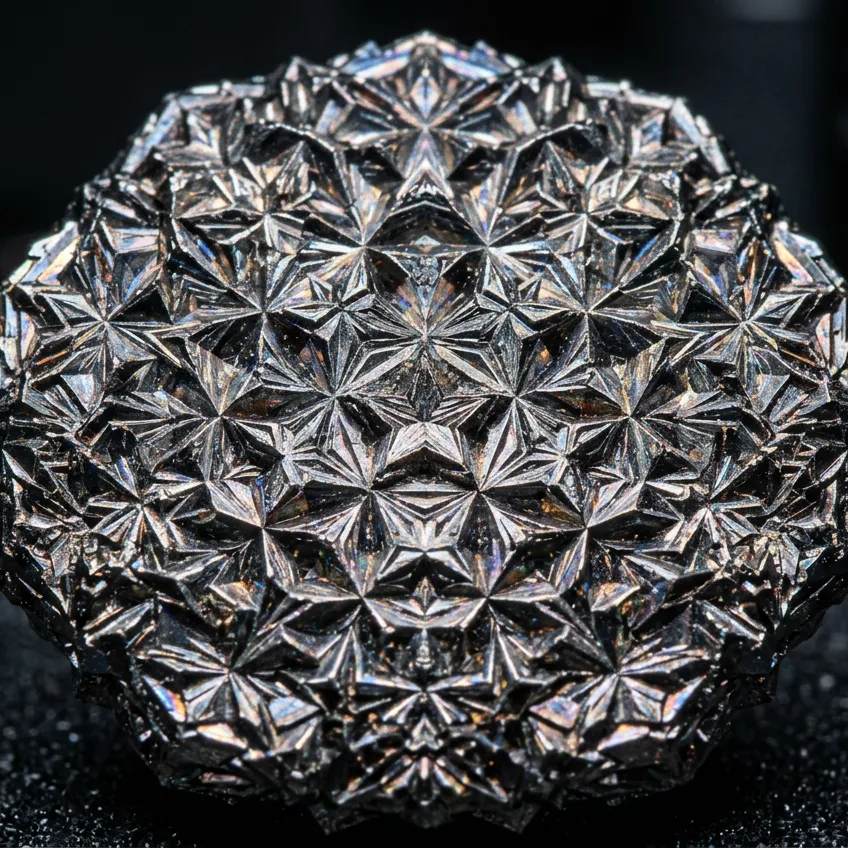
For more than two centuries, crystallography relied on an unbreakable dogma: in a crystalline solid, atoms are arranged in a strictly periodic and repeating manner. Mathematically, this limited the permitted rotations to 2-, 3-, 4-, or 6-fold symmetries. A 5-fold or 10-fold symmetry was considered as impossible as trying to tile a flat floor with regular pentagons without leaving empty gaps.
On April 8, 1982, Israeli scientist Dan Shechtman observed a rapidly cooled aluminum and manganese alloy through a transmission electron microscope. The diffraction pattern clearly revealed a 10-fold rotational symmetry. Baffled, Shechtman wrote in his notebook: «10 Fold???». Upon presenting his results, his laboratory director handed him a basic crystallography textbook suggesting he study more, and shortly afterward he was expelled from the team for allegedly bringing disgrace to the department. Even the renowned two-time Nobel laureate Linus Pauling publicly declared: «There are no quasicrystals, only quasi-scientists».
Shechtman did not give up and proved that a new form of matter existed: quasicrystals. They possessed a rigorous atomic order that was non-periodic, analogous to the aperiodic tilings conceived by mathematician Roger Penrose. Decades later, these structures were not only synthesized in laboratories, but also discovered in the Khatyrka meteorite and in trinitite melted by the first atomic bomb. In 2011, Shechtman was awarded the Nobel Prize in Chemistry alone, forever transforming our understanding of the solid state.
Source: The Royal Swedish Academy of Sciences - The Nobel Prize in Chemistry 2011



