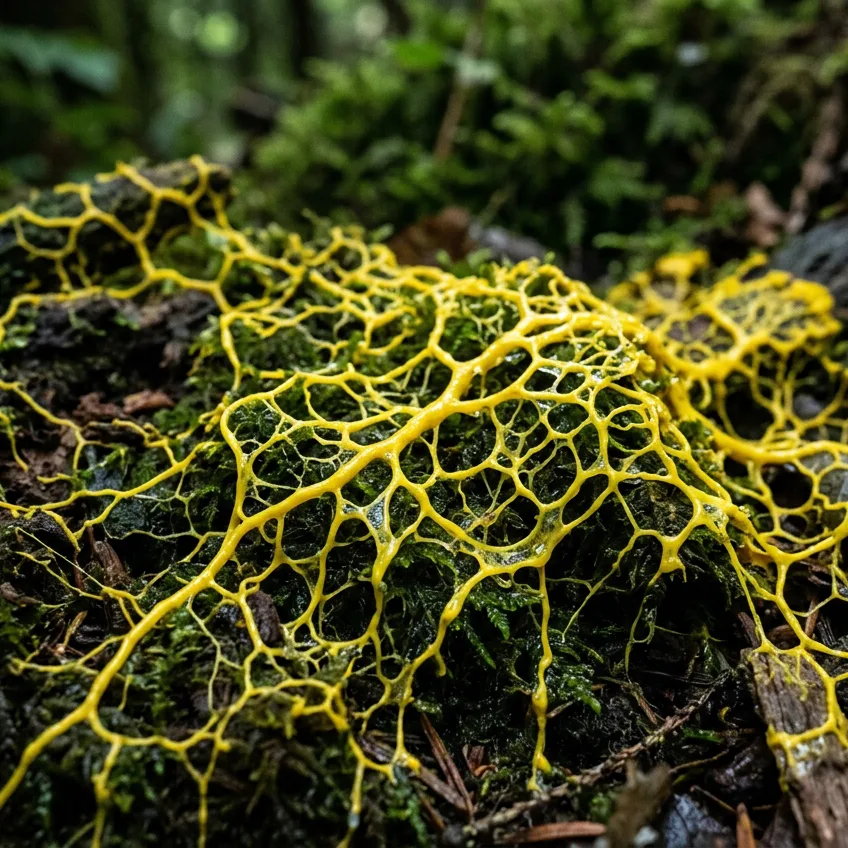
At first glance it looks like a yellowish, slimy mass straight out of a science fiction movie, but Physarum polycephalum is one of the most fascinating biological enigmas on the planet. It does not belong to the fungi, plant, or animal kingdoms; it is classified as a myxomycete protist. The extraordinary thing is that its entire structure, which can cover square meters on the floor of humid forests, is actually a single giant multinucleated cell.
Despite completely lacking a nervous system or a brain, this organism exhibits astonishing forms of information processing and decision-making:
- Maze solving: In 2000, Japanese researcher Toshiyuki Nakagaki demonstrated in the journal Nature that if oat flakes are placed at the entrance and exit of a maze, the mold retracts its fruitless filaments and connects both food sources by following the shortest geometric path with absolute precision.
- Transportation engineering: In 2010, scientists replicated the geography of Tokyo by placing oat grains at the locations of surrounding cities. In just twenty-six hours, the mold's cytoplasmic flow traced a network of interconnected tubes virtually identical to the efficiency and redundancy of the Japanese subway network.
- Memory without neurons: If exposed to periodic pulses of cold, dry air at constant intervals, Physarum learns the rhythm and slows its growth rate before the next blast of cold occurs, anticipating the environmental change.
This decentralized intelligence is based on the biomechanics of its peristaltic flow: rhythmic contractions of actin and myosin pump nutrients and reshape the thickness of the tubes according to pressure and chemical signals, proving that biological computing does not require neurons to solve complex problems.
Source: Nature (Nakagaki et al., 'Intelligence: Maze-solving by an amoeboid organism') / Science (Tero et al., 'Rules for Biologically Inspired Adaptive Network Design')