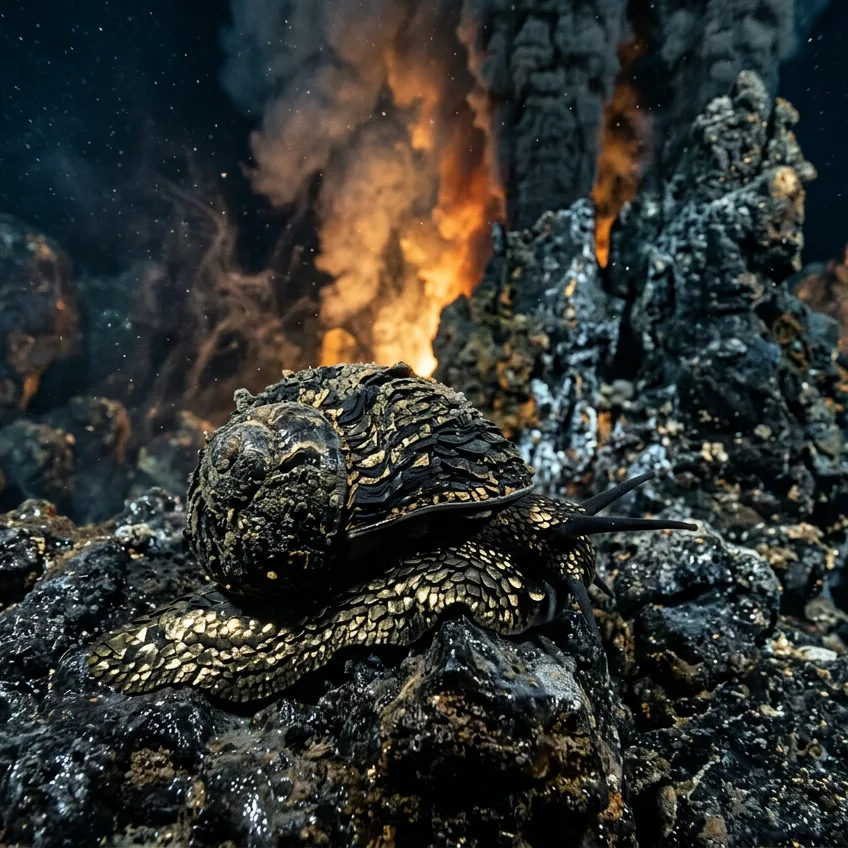
More than 2,400 meters deep in the hydrothermal vents of the Indian Ocean, where water emerges from the depths of the Earth loaded with minerals at temperatures exceeding 350 °C and without a ray of sunlight, lives one of the most astonishing creatures of evolution: Chrysomallon squamiferum, popularly known as the scaly-foot snail or sea pangolin.
Discovered in 2001 in the Kairei hydrothermal field, this gastropod stands out as the only living organism capable of mineralizing heavy transition metals to build its exoskeleton. Its shell features a sophisticated three-layer structure that has fascinated materials engineers: a classic inner layer of calcareous aragonite, a soft and flexible organic sponge middle layer that absorbs impacts, and an outer armor hardened with iron sulfides, mainly pyrite and greigite.
This combination not only provides it with impenetrable armor against the crushing claws of abyssal crabs, but also gives it an unusual property in the animal kingdom: it is magnetic, since greigite is a natural ferromagnetic mineral. In addition, the snail does not feed by chewing algae or hunting prey; its huge esophageal gland houses millions of endosymbiotic bacteria that oxidize toxic sulfur from the seabed to supply nutrients directly to its biological bloodstream.
Source: National Geographic / Proceedings of the National Academy of Sciences (PNAS)