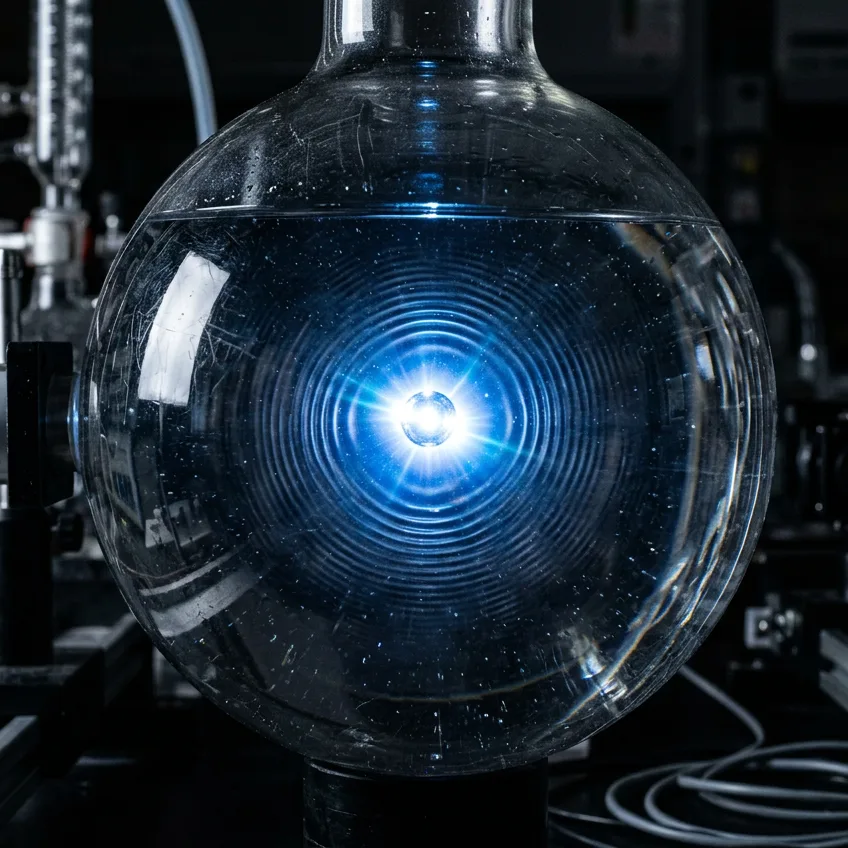
In 1934, German physicists H. Frenzel and H. Schultes accidentally discovered a phenomenon so baffling that it seemed to defy common sense: subjecting a flask of liquid to high-frequency sound waves caused tiny flashes of visible light to emerge. This effect was named sonoluminescence, the direct conversion of acoustic energy into light photons.
The mechanism behind this glow is one of the most extreme demonstrations of energy concentration in nature:
- Acoustic cavitation: When ultrasound waves pass through water, they generate extreme pressure oscillations that expand and contract a small gas bubble trapped in the fluid.
- Supersonic collapse: As the surrounding pressure rises, the bubble walls collapse inward at supersonic speeds, shrinking to a fraction of their diameter in just picoseconds.
- Solar heat: This quasi-adiabatic collapse compresses the gas inside so intensely that it generates a brutal thermal shock wave. Spectroscopic measurements have revealed internal temperatures exceeding 15,000 and even 20,000 Kelvin, figures considerably higher than the visible surface of the Sun (5,778 K).
Under these massive conditions, the noble gas atoms in the bubble briefly ionize to form a microscopic plasma that, upon recombining and cooling in a trillionth of a second, releases a burst of bluish light. Today, laboratories study sonoluminescence to investigate cold plasma physics, sound-accelerated chemical reactions, and quantum fluid dynamics models.
Source: Nature Physics / American Physical Society (Physical Review Letters)