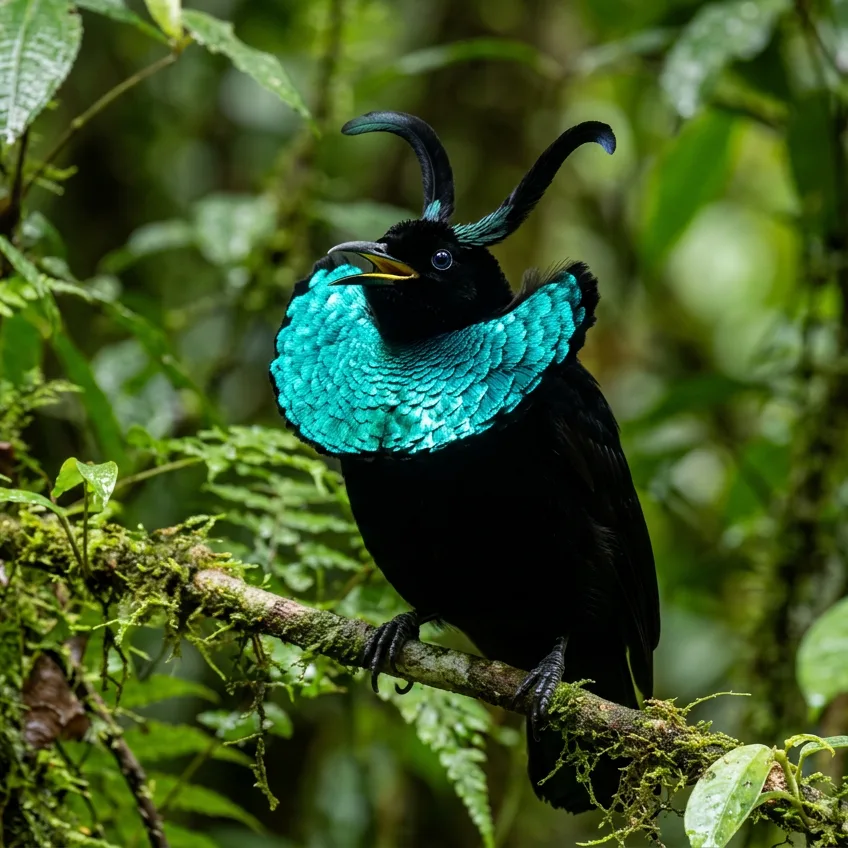
In the rainforests of New Guinea lives a creature capable of defying the usual laws of optics: the superb bird-of-paradise (Lophorina superba). During its elaborate courtship ritual, the male displays a cape of feathers so deeply dark that the human eye can barely distinguish textures or contours on its surface; it resembles a silhouette cut out of void.
Research led by biologists from Harvard University and the Smithsonian Institution revealed in 2018 that these feathers do not owe their blackness solely to melanin concentration. Using scanning electron microscopy, they discovered that the feather barbules feature an intricate branched three-dimensional architecture that acts like a microscopic maze. When photons enter this structure, they bounce repeatedly between curved cavities instead of reflecting outward, trapping up to 99.95 % of incident light.
This absorption capacity directly rivals advanced synthetic materials like Vantablack, designed by aerospace engineers to coat high-precision telescopes. In the case of the bird of paradise, the selective pressure was not astrophysics, but seduction:
- Extreme contrast effect: the super-black background tricks the visual perception of females, causing the iridescent blue and turquoise flashes on its chest to appear to emit their own light.
- Convergent evolution: this same biological nanotechnology trick has evolved independently in butterflies, peacock spiders, and certain vipers.
Source: Nature Communications (McCoy et al., 2018 - 'Structural absorption by barbule microstructures of super black bird of paradise feathers')