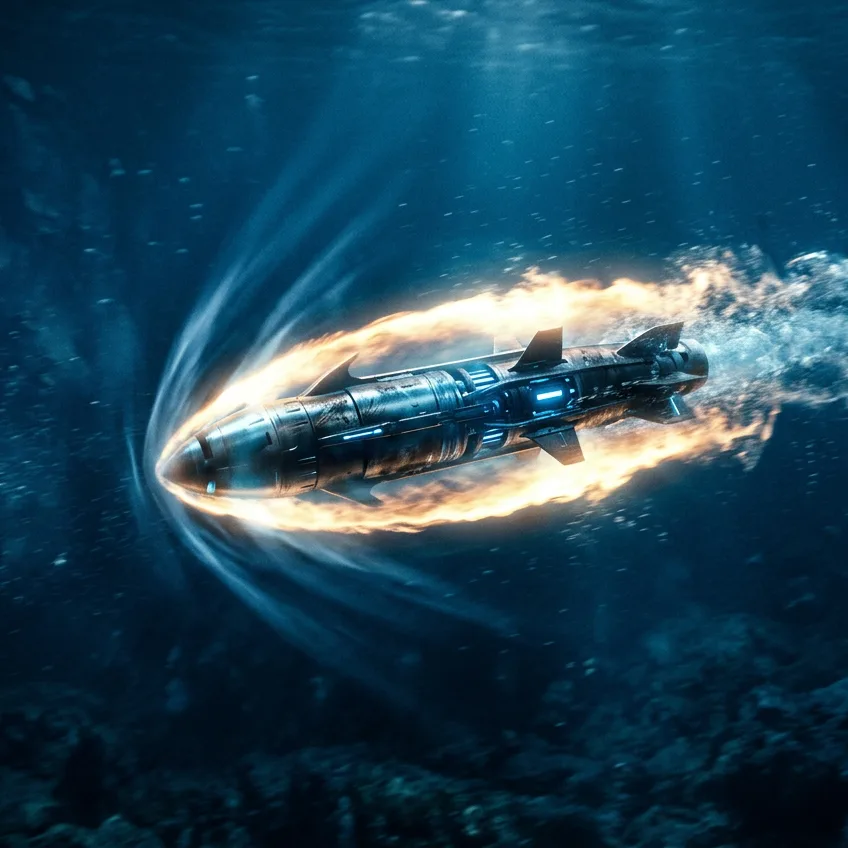
In water, the density is approximately 800 times higher than that of air, imposing formidable hydrodynamic drag on any moving body. However, physics devised an extraordinary shortcut: supercavitation. This phenomenon occurs when an object travels at such high speed that local fluid pressure plummets below the vapor pressure of water, triggering instant vaporization and creating a massive gas bubble that envelops nearly the entire body.
Surrounded by vapor rather than liquid water, physical contact with the fluid is limited solely to the front nose (called the cavitator). This reduces skin friction drag by up to 90%, allowing the object not to swim, but to literally "fly" inside a submerged cocoon of gas.
The most iconic application of this principle is the VA-111 Shkval torpedo, designed during the Cold War and capable of exceeding 370 km/h (around 200 knots), more than tripling the speed of any conventional torpedo. However, mastering supercavitation presents titanic engineering challenges:
- Control and steering: Traditional rudders are useless floating inside the bubble's void, requiring vector thrust nozzles.
- Ventilated cavitation: To sustain a stable cavity, exhaust gases are actively injected from the nose cone toward the flanks.
Today, this phenomenon inspires civil prototypes for ultra-efficient ship hulls and research into high-speed underwater exploration.
Source: Journal of Fluid Mechanics / Scientific American