In our daily lives, water only appears in three classic states: steam, liquid, or freezing ice. However, in the extreme depths of planets like Uranus and Neptune, water takes on an exotic and puzzling state known as superionic ice (or ice XVIII), where the properties of a rigid solid and a conductive fluid coexist at the same time.
This phenomenon was predicted theoretically in 1988 and confirmed experimentally in 2019 at the Lawrence Livermore National Laboratory. To recreate it, physicists bombarded microscopic water droplets with powerful laser pulses, generating shock waves with pressures exceeding three million atmospheres and temperatures of almost 3,000 °C.
Under these immense conditions, a fascinating transformation takes place:
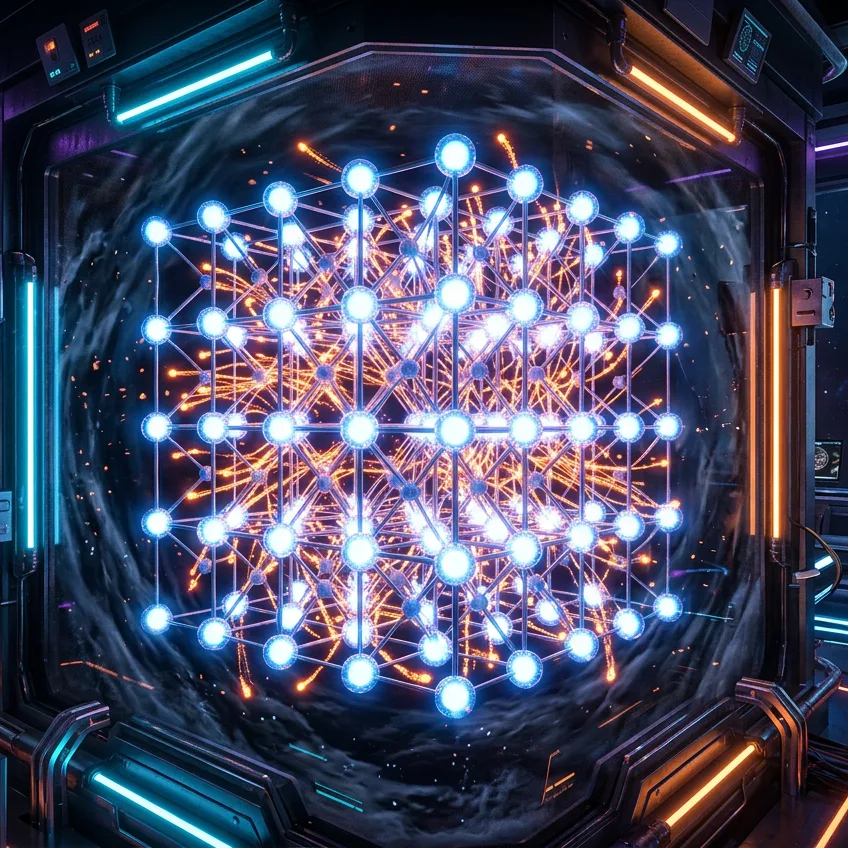
- Crystalline skeleton: Oxygen atoms become so compressed that they crystallize into a completely solid cubic lattice.
- Protonic fluid: Covalent bonds break, and hydrogen ions (protons) move with absolute freedom through the spaces in the crystal lattice, flowing like a liquid.
- Extreme properties: Unlike regular ice, superionic ice is dense, opaque black, and conducts electricity almost as well as a noble metal.
This discovery resolved one of the greatest puzzles in planetary astrophysics: the origin of the strange, asymmetrical, and tilted magnetic fields of the ice giants, generated not by a molten iron core, but by colossal internal mantles of boiling superionic water.
Source: Nature (Millot et al., 'Nanosecond X-ray diffraction of shock-compressed superionic water ice')