Every morning when you get out of bed or stand up quickly from the couch, your body faces an instantaneous hemodynamic crisis. In less than a second, gravity displaces between 500 and 800 milliliters of blood toward the veins in your legs and abdomen. If that volume were not redistributed immediately, blood pressure would plummet, the brain would be starved of oxygen, and you would lose consciousness at once. What prevents this collapse is the baroreceptor reflex.
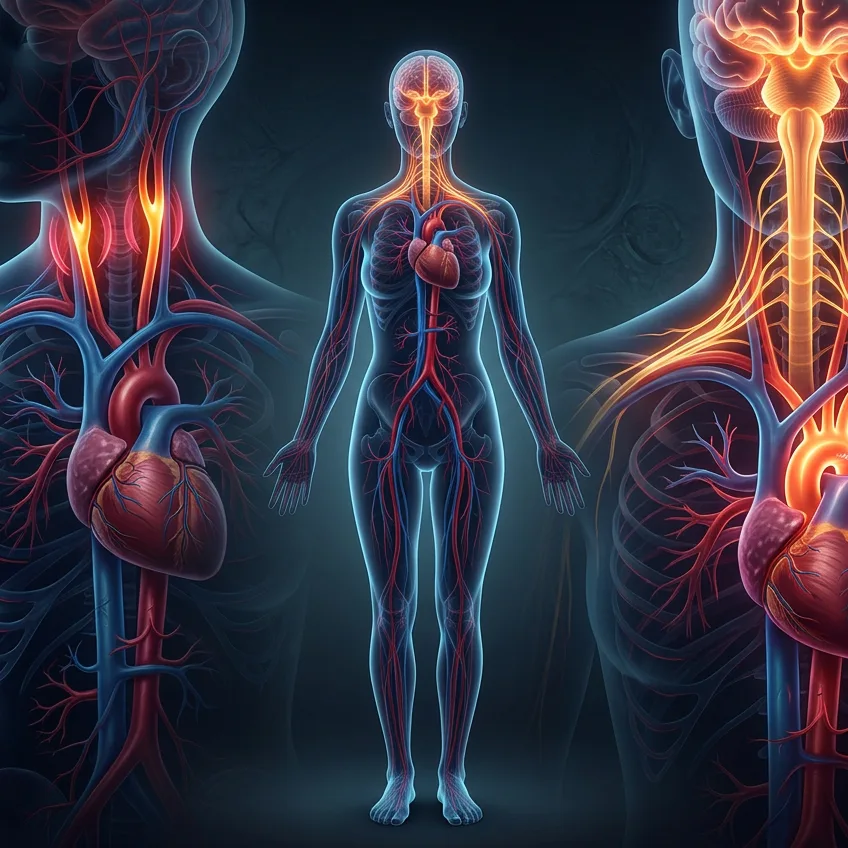
This safety mechanism depends on clusters of microscopic mechanoreceptors embedded in the walls of two critical locations: the carotid sinus (in the neck, on the way to the brain) and the aortic arch (at the direct exit of the heart). These nerve endings measure with millimeter precision how much the artery stretches with each heartbeat:
- Instant detection: When you stand up, the sudden drop in blood reduces tension in the arterial walls, slowing the stretch signal.
- Brainstem response: The brainstem interprets this drop as an emergency and releases the parasympathetic brake while triggering a massive sympathetic surge.
- Adjustment in milliseconds: In less than two heartbeats, arterioles constrict and the heart increases its rate and pumping force, restoring systemic pressure.
This reflex arc is one of the fastest homeostatic circuits in human biology. When the system loses sensitivity due to dehydration, extreme fatigue, or aging, what is known as orthostatic hypotension occurs: that brief dizziness with blurred vision that reminds you of the silent miracle occurring in your arteries thousands of times a day.
Source: American Physiological Society (APS) / Hall, J. E. (2020). Guyton and Hall Textbook of Medical Physiology.