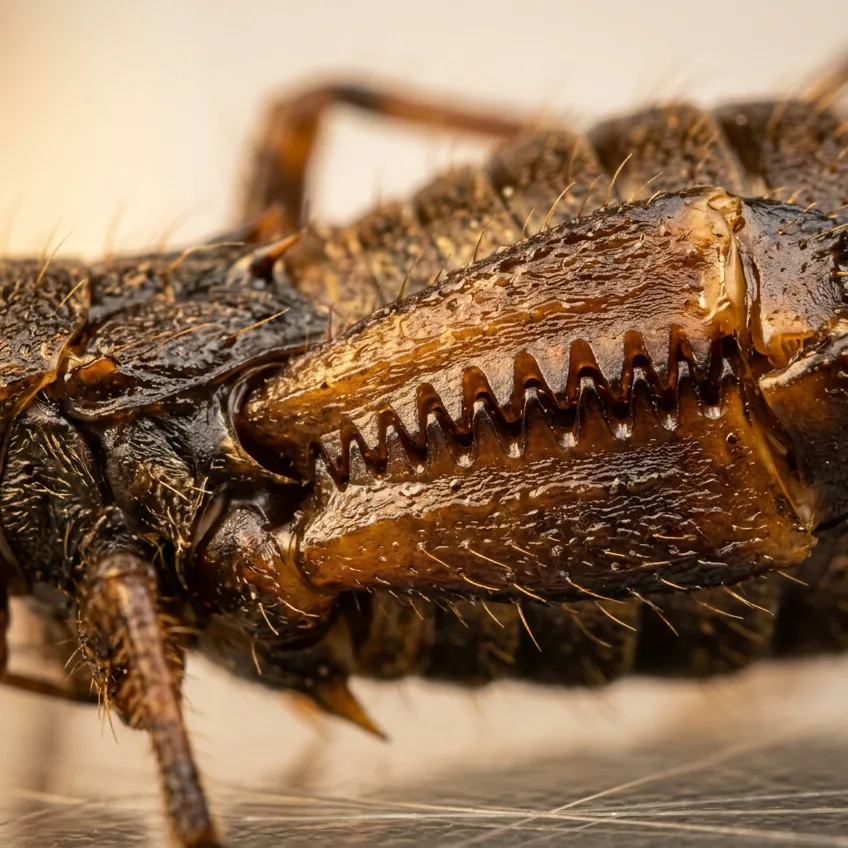
For centuries, it was assumed that mechanical gears and interlocking cogwheels were an exclusive creation of human ingenuity. However, in 2013, scientists from the University of Cambridge discovered that nature had developed this mechanism millions of years earlier in a tiny European insect: Issus coleoptratus.
To escape predators, this dwarf planthopper executes explosive jumps at prodigious speeds. However, it faced a biophysical dilemma: if one hind leg fired a thousandth of a second before the other, the insect would spin uncontrollably. Because nervous system impulses are too slow to coordinate both limbs with such precision, evolution designed a direct physical solution.
The biomechanics of its joint are astonishing:
- Chitin teeth: At the base of its hind legs (the trochanters), the nymph features two opposing curved strips equipped with between 10 and 12 perfectly carved microscopic teeth.
- Microsecond synchronization: When jumping, the teeth on both legs interlock exactly like the gears of a Swiss watch, synchronizing the movement of both limbs in just 30 microseconds (thirty millionths of a second).
- A juvenile trick: This structure exists only during the nymph stage; upon molting into the adult phase, the insect loses the teeth and relies on friction, as a break in adulthood would be irreparable.
This discovery showed that the functional gear wheel was not invented by human engineering, but unconsciously copied from the complex wonders of biological evolution.
Source: Science journal (Burrows & Sutton, 2013) / University of Cambridge