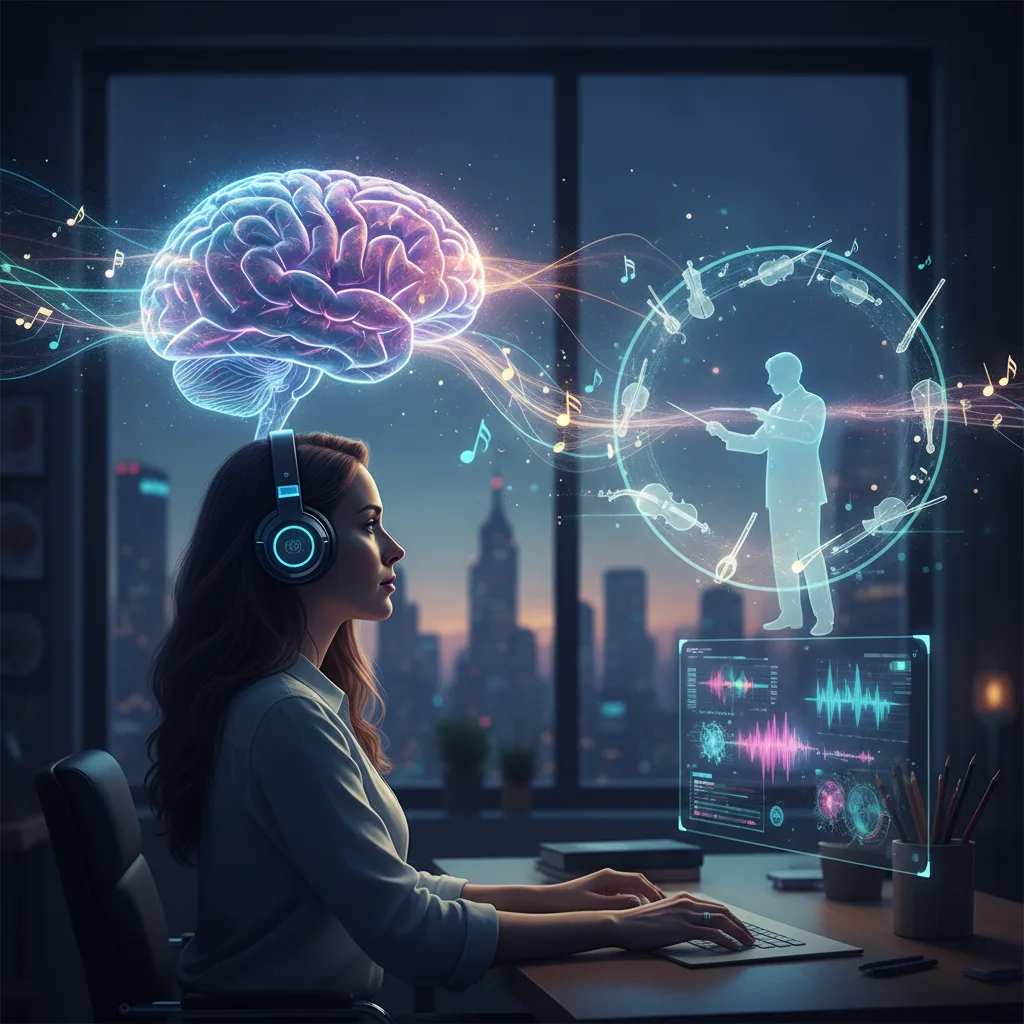
Scientists at the Max Planck Institute for Neuroscience have developed a revolutionary technique that converts a person's unique brainwave patterns into personalized musical pieces. Using high-resolution electroencephalography (EEG), they capture electrical activity in the prefrontal cortex during concentration tasks. This data is processed in real time through artificial intelligence algorithms that assign specific frequencies to different brainwave bands.
The alpha band (8-12 Hz), associated with states of alert relaxation, translates into gentle piano melodies, while beta waves (13-30 Hz), linked to active focus, generate more complex rhythms with strings and percussion. In studies published in the journal Nature Neuroscience in 2023, participants who listened to their own 'brain symphonies' for 30 minutes showed a 42% increase in information retention and a 38% reduction in mental fatigue compared to control groups.
- The system adapts the music based on detected brain fatigue
- It can identify distraction patterns and adjust the composition to redirect focus
- Experimental versions are already being tested in treatments for ADHD
This technology, dubbed 'NeuroSoniq', represents a new paradigm in auditory biofeedback, where our brain literally composes the ideal soundtrack for its own optimal performance.
Source: Max Planck Institute for Neuroscience, study published in Nature Neuroscience (2023)