Is it possible to photograph what is hidden behind a wall without peeking? Although it sounds like an optical contradiction, applied physics has shown that it is. This is non-line-of-sight imaging (Non-Line-of-Sight Imaging or NLOS), a revolutionary technology capable of mapping entire three-dimensional scenes blocked by opaque obstacles.
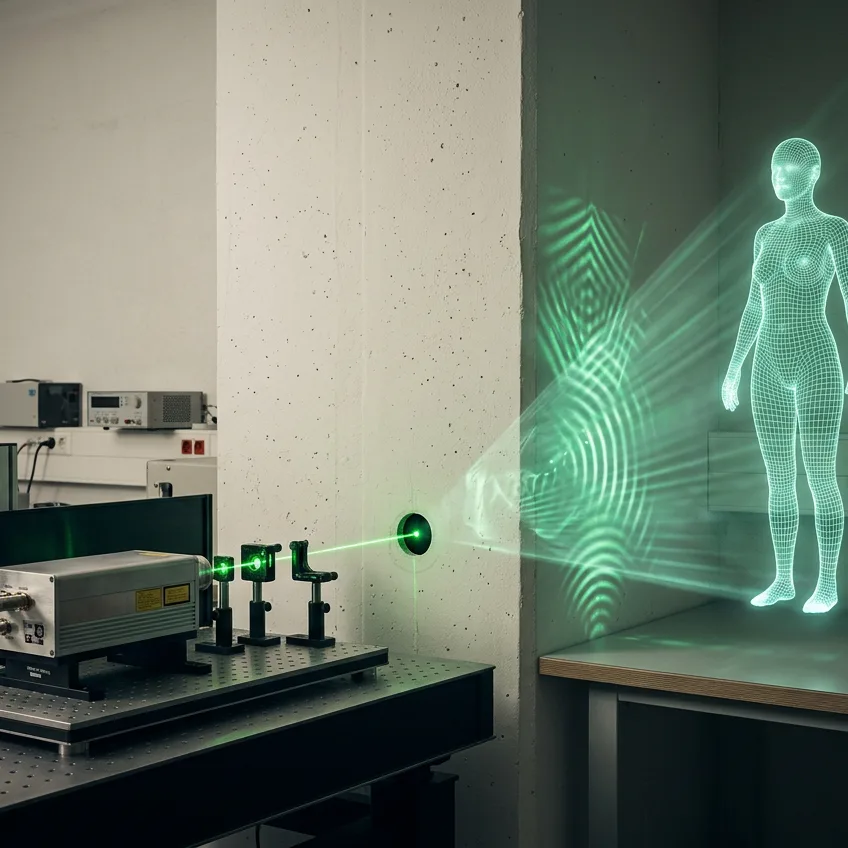
The fundamental principle relies on calculating the temporal echo of light. The device fires ultrashort laser bursts, with durations measured in femtoseconds (the quadrillionth part of a second), directed toward a diffuse reflective surface, such as a normal wall or the floor. Upon impact, the light bounces in multiple directions: a tiny fraction of those photons travels toward the object hidden around the corner, bounces off it, and returns once more toward the visible wall.
To capture this faint glimmer of light, single-photon avalanche diodes (SPAD) are used, ultrasensitive detectors that measure the arrival of individual light particles with picosecond precision. By computing the infinitesimal differences in the time of flight of each returning photon, complex tomographic reconstruction algorithms deduce the shape, distance, and even movement of the object invisible to the human eye.
This breakthrough transforms safety and applied science in multiple areas:
- Autonomous vehicles: It allows anticipating pedestrians or cars crossing blind corners before they enter the road.
- Rescue operations: It makes it easier to detect survivors trapped in labyrinths of rubble or rooms filled with dense smoke.
- Medicine and endoscopy: It opens the door to visualizing blood vessels hidden behind tissue folds without the need for invasive incisions.
Source: Nature Photonics / MIT Media Lab (Camera Culture Group)