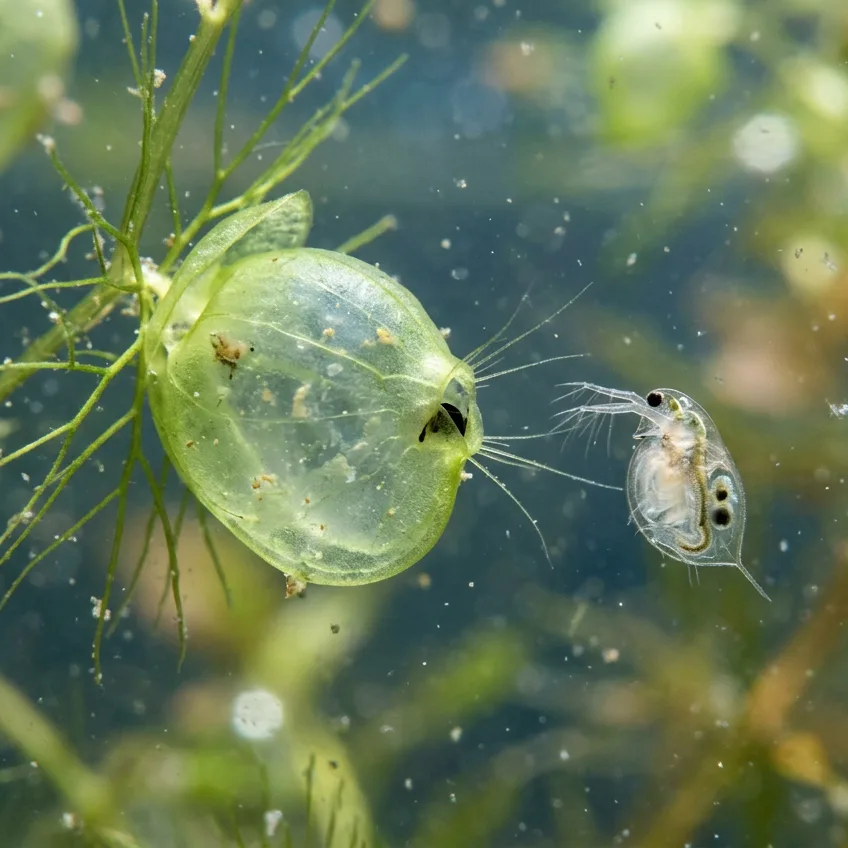
While the famous Venus flytrap needs a tenth of a second to snap its leaves shut, an infinitely faster plant hunter lives in the freshwaters of rivers and peat bogs: Utricularia, popularly known as the bladderwort. This carnivorous plant lacks true roots, but has developed tiny transparent bladders of just a few millimeters capable of executing the fastest carnivorous movement on the planet.
The secret of its lethal efficiency lies in a sophisticated negative pressure mechanism. The plant actively pumps water out of the bladder through microscopic glands, bending its walls inward and storing elastic energy, much like a spring compressed to its limit. The entrance is sealed by a flexible, airtight door equipped with ultra-fine trigger hairs that act as a detonator.
When a tiny aquatic crustacean—such as a water flea or a mosquito larva—accidentally brushes against these sensory hairs, the elastic seal breaks in a physical process known as elastic buckling:
- The trapdoor folds inward in just 0.5 milliseconds (500 microseconds).
- The pressure difference creates a violent whirlpool that sucks in water and prey with accelerations exceeding 600 G.
- The door slams shut after the implosion before the victim can react.
Once captured, the prey is broken down by digestive enzymes and symbiotic bacteria in a matter of hours. The bladder expels the water once again and resets the mechanical vacuum, ready to set a new ambush in less than half an hour.
Source: Proceedings of the Royal Society B: Biological Sciences (CNRS / Université Joseph Fourier)